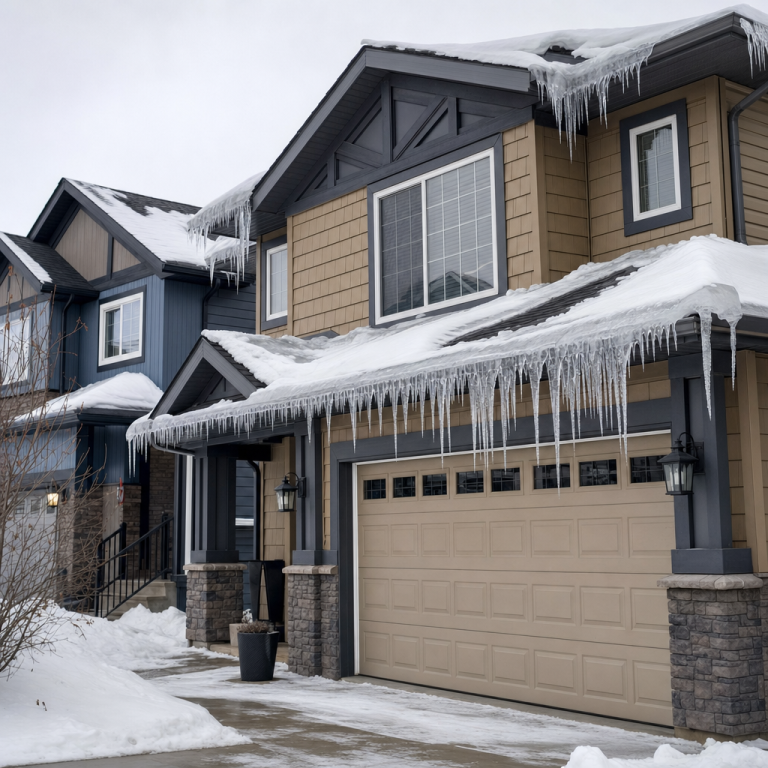
Calgary commercial properties face serious risks from heat loss through roof assemblies, rising energy costs, ice dam formation, moisture infiltration, and structural damage. Ice dams pose serious financial and operational risks to Calgary commercial properties. When warm air escapes through roof assemblies, it melts snow that refreezes at colder roof edges, creating ice barriers that trap water and damage building infrastructure. Commercial buildings face unique challenges compared to residential structures. Larger roof spans, complex HVAC systems, and higher occupancy loads increase heat loss and ice dam vulnerability.
At Eco Attic Solutions Inc., we have observed how professional air-sealing attics in Calgary address ice dam formation while delivering measurable energy savings and protecting commercial property investments across diverse building types.

Why Ice Dams Threaten Calgary Commercial Buildings
Ice dams create cascading problems for commercial property owners. Canadian insurance industry data reveals the substantial costs associated with water infiltration incidents affecting commercial properties nationwide.
Structural Damage Costs and Roof Membrane Deterioration
Water backup from ice dams penetrates roof membranes, deteriorates insulation materials, and compromises structural elements. The Insurance Bureau of Canada reports 2024 saw commercial property insured losses reach over $1.7 billion, the second-highest total in Canadian history. Flooding alone has caused an average of $800 million in insured losses annually over the past decade. Repeated freeze-thaw cycles weaken membrane seals, accelerate fastener corrosion, and reduce roof system lifespan substantially.
Business Disruption from Water Infiltration
Water entering through compromised roof systems damages inventory, disrupts operations, and creates liability exposure. Statistics Canada’s analysis of the Canadian property and casualty insurance industry shows that catastrophic weather events, including ice dam-related incidents, totaled $3.1 billion in insured losses in 2023. Retail spaces face additional losses from damaged merchandise, while office buildings experience productivity declines and potential equipment failures. The cumulative effect of unplanned closures creates substantial revenue impacts beyond immediate repair costs.
Liability Concerns for Property Managers
Property managers face legal exposure when ice dam-related water damage affects tenants or creates safety hazards. Falling ice from commercial buildings injures pedestrians, damages vehicles, and triggers insurance claims. Alberta building codes require property owners to maintain safe conditions, making proactive ice dam prevention both financially prudent and legally necessary. The Building Owners and Managers Association of Canada emphasizes that commercial real estate owners must implement flood-resilience measures to reduce property damage, business disruptions, and liability risks.
The Science Behind Commercial Attic Air-Sealing for Ice Dam Control
Understanding heat loss mechanisms explains why commercial attic air-sealing service prevents ice dam formation more effectively than adding insulation alone.
Heat Loss Pathways in Commercial Roof Assemblies
Commercial buildings lose heat through three primary pathways: conduction through building materials, convection via air movement, and radiation. Research from the Journal of Building Engineering published in ScienceDirect, examining six Canadian commercial buildings, found that air leakage is responsible for 5-30% of building heating loads, with infiltration accounting for approximately 25% of heating loads in newer buildings with higher insulation levels. Warm air escaping through gaps around HVAC penetrations, electrical conduits, and structural joints rises to the roof deck, creating localized warm zones that melt snow.
How Air Leakage Differs from Residential Applications
Commercial buildings present distinct air-sealing challenges. Larger roof spans create greater pressure differentials, increased mechanical equipment generates more heat sources, and higher occupant densities produce elevated internal temperatures. Building airtightness testing of Canadian commercial properties demonstrates notable variation between buildings, with most commercial buildings conforming to ASHRAE 90.1 standard values but showing opportunities for improvement through professional air-sealing interventions.
Temperature Differential Data and Ice Formation Patterns
Ice dams form when roof surface temperatures exceed 0°C while ambient air remains below freezing. Research on ice dam formation in Calgary demonstrates that heat flowing from buildings creates nonuniform roof temperatures. According to Calgary roofing industry analysis, when higher portions of roof surfaces rise above 0°C while lower sections remain below freezing, melting snow flows downward. It refreezes at colder edges, forming ice dams. Commercial buildings with inconsistent attic temperatures, common in facilities with varied ceiling heights or partially heated spaces, experience ice dam formation along temperature transition zones.
| Building Type | Air Leakage Characteristics | Heat Loss Pattern | Ice Dam Risk |
| Warehouse | High ceiling heights, loading dock areas | 25-35% from air leakage | High |
| Retail | HVAC serving high-traffic zones | 30-40% from air leakage | Very High |
| Office | Multi-story stack effect pressure | 25-35% from air leakage | High |
| Mixed-use | Variable occupancy patterns | 30-45% from air leakage | Very High |
Source: ScienceDirect, Natural Resources Canada
Commercial Attic Insulation Assessment: Identifying Vulnerable Areas
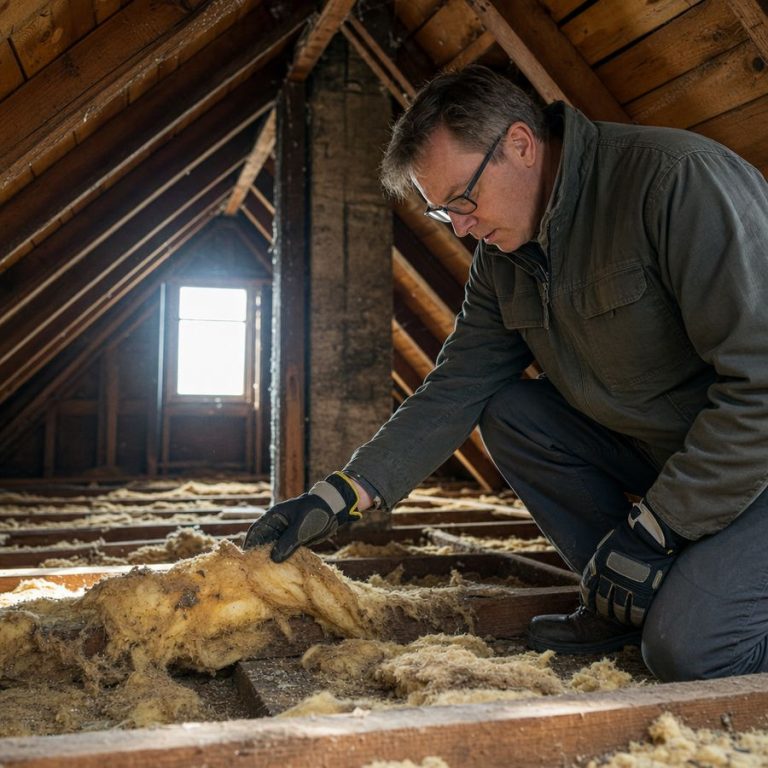
A thorough commercial attic insulation inspection is essential for identifying heat loss, air leakage, and insulation deficiencies that increase operating costs and compromise building performance. Eco Attic Solutions conducts systematic evaluations of commercial properties across Calgary to pinpoint vulnerable attic and roof-assembly areas requiring targeted insulation upgrades and air-sealing interventions. This assessment-driven approach allows facility managers and property owners to address inefficiencies at their source, improve thermal consistency, and support long-term compliance with evolving building performance standards.
High-Risk Zones in Warehouses, Retail Spaces, and Office Buildings
Different commercial building types exhibit characteristic vulnerability patterns. Warehouses commonly show heat loss around loading dock areas and through roof-mounted HVAC units. Retail spaces experience concentrated leakage near lighting fixtures and around mechanical systems serving customer areas. Office buildings demonstrate air leakage at floor-ceiling interfaces, particularly in multi-story structures where vertical shafts create stack effect pressure.
Thermal Imaging Inspection Protocols
Infrared thermography provides objective data about heat loss locations. Professional evaluations conducted during cold weather conditions reveal thermal signatures invisible to visual inspection. At Eco Attic Solutions, we utilize building airtightness testing using blower door pressurization and depressurization methods, combined with infrared scanning, to enable comprehensive identification of air leakage pathways in commercial roof assemblies across Calgary properties.
Existing Insulation Evaluation and Building Envelope Analysis
Many Calgary commercial buildings constructed before 2000 contain insulation below current Alberta Building Code standards. Beyond insulation R-value, evaluations examine air barrier continuity, vapor retarder condition, and ventilation adequacy. NRCan says that you should air-seal and ventilate together. Air leaks can carry moisture into your home and cause condensation, so upgrades should stop heat loss while preventing moisture buildup.
Professional Air-Sealing Techniques for Commercial Attic Spaces
Effective ice dam prevention requires specialized materials and installation methods appropriate for commercial applications.
Spray Foam Applications vs. Mechanical Sealing Methods
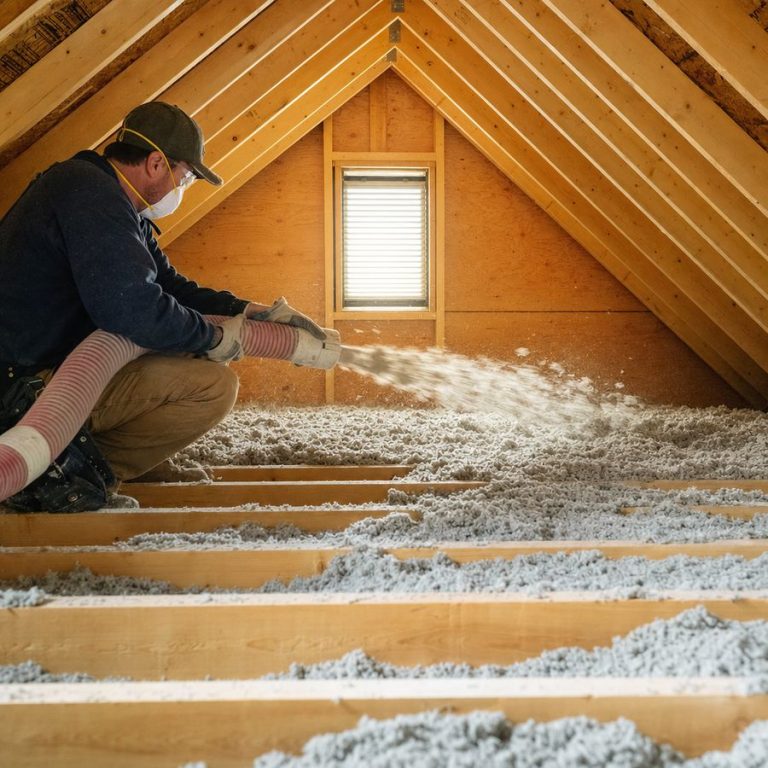
Closed-cell spray foam provides both air-sealing and insulation enhancement in a single application, making it efficient for large commercial projects. Two-part polyurethane foam expands to fill irregular gaps and creates continuous air barriers around complex penetrations. Mechanical sealing using gaskets, weatherstripping, and caulking compounds offers cost advantages for buildings with accessible, regular penetration patterns. Material selection depends on penetration size, accessibility constraints, and building code requirements.
Roof Insulation Integration with Ventilation Systems
Commercial roof assemblies require balanced ventilation to manage moisture while preventing heat loss. Air-sealing must maintain proper ventilation pathways, blocking air leakage through the building envelope while preserving intentional ventilation channels. NRCan’s Keeping the Heat In guidance notes that peaked-roof attics are commonly ventilated using a 1:300 ratio (unobstructed vent area to insulated ceiling area) and emphasizes coordinating ventilation with air-sealing and insulation to manage moisture.
Code Compliance for Commercial Building Standards in Alberta
The Alberta Building Code mandates specific performance requirements for commercial roof assemblies. A commercial insulation contractor must verify that air-sealing improvements meet fire resistance ratings, vapor permeance specifications, and structural load requirements.
Recent code updates emphasize continuous air barrier systems rather than component-based approaches, reflecting recognition of air leakage’s role in building performance.
| Air-Sealing Method | Application | Typical Benefits |
| Closed-cell spray foam | Irregular penetrations, roof-wall connections | Air barrier + insulation combined |
| Open-cell spray foam | Large cavity areas | Lower cost, good air-sealing |
| Mechanical sealing | Accessible joints, regular patterns | Cost-effective for simple applications |
| Combination approach | Complex assemblies | Optimized performance and cost |
Source: Natural Resources Canada, ScienceDirect
Beyond Ice Dams: Additional Benefits of Commercial Attic Air-Sealing Service
Ice dam prevention represents one component of broader building performance improvements delivered through professional air-sealing.
Annual Energy Cost Reductions for Calgary Businesses
Reduced air leakage directly lowers heating costs. ENERGY STAR guidance indicates that sealing air leaks and adding insulation can reduce energy waste and improve efficiency. While exact savings vary by building, audits often show double-digit percentage reductions in annual heating and cooling costs following comprehensive air-sealing and insulation upgrades.
Studies of commercial building air-sealing projects show that total percentage energy savings range between 6% and 63.4%, depending on building type, climate, and existing leakage rates. For Calgary commercial properties, these savings translate to substantial annual cost reductions while improving occupant comfort.
HVAC System Efficiency Improvements and Equipment Longevity
Air-sealed buildings require less heating capacity, reducing runtime hours and equipment wear. Research demonstrates that air-sealing reduces the workload on HVAC equipment, mitigating wear and tear while minimizing the need for repairs and replacements. In commercial applications, where HVAC accounts for 34% of energy consumption, reducing air leakage delivers measurable operational benefits. Calgary’s temperature extremes place exceptional demands on heating systems. Minimizing air leakage reduces thermal stress on equipment during cold snaps.
Indoor Air Quality Enhancement and Moisture Control
Controlled ventilation systems function more effectively when buildings maintain proper air barriers. Random air leakage introduces unfiltered outdoor air, dust, and pollutants while making mechanical ventilation less predictable. Moisture control improves as air barriers prevent warm, humid interior air from contacting cold roof deck surfaces where condensation forms. Natural Resources Canada guidelines emphasize that controlling airflow protects building materials from moisture damage while improving comfort and creating cleaner, healthier indoor environments.
Selecting a Commercial Insulation Contractor in Calgary
Project success depends on contractor qualifications, experience, and coordination capabilities.
Certification Requirements and Insurance Verification
Qualified contractors providing roof insulation for commercial buildings hold certifications from recognized industry organizations. Verify that contractors carry a minimum of $5 million commercial general liability insurance and workers’ compensation coverage appropriate for commercial construction projects. Bonding requirements vary by project size but provide financial protection for building owners. Professional contractors maintain up-to-date knowledge of Alberta Building Code requirements and material specifications.
Experience with Commercial Roof Assemblies
Commercial roof systems require knowledge of flat roof construction, steel deck assemblies, and HVAC integration. Request references from similar building types—warehouses require different approaches than office buildings or retail centers. Review completed projects to assess quality standards, timeline adherence, and problem-solving capabilities when unexpected conditions arise. Experienced contractors understand how commercial building occupancy patterns affect project scheduling and execution.
Project Timeline Considerations and Business Operation Coordination
Commercial projects demand scheduling that minimizes tenant disruption and maintains business operations. Experienced contractors develop phased approaches allowing sections of buildings to remain operational during work. At Eco Attic Solutions, we coordinate project timing with facility managers to address immediate ice dam concerns while maintaining business continuity. Winter projects may face weather limitations, but address urgent ice dam risks, while summer scheduling provides ideal working conditions for roof access and material installation.
Our Commercial Insulation Service Approach
Eco Attic Solutions specializes in commercial attic insulation in Calgary, air-sealing, and ventilation services for businesses. While ice dam prevention is not our primary specialty, proper air-sealing and insulation naturally reduce the heat loss that contributes to ice dam formation. Our whole-building approach addresses the root causes of energy waste and winter weather damage, with ice dam risk reduction as one of many benefits our clients experience.
Protect Your Commercial Property This Winter
Calgary’s winter conditions create ongoing ice dam risks for commercial properties, but professional air-sealing provides lasting protection while reducing operational costs. Eco Attic Solutions specializes in commercial attic air-sealing service for warehouses, retail spaces, and office buildings throughout Calgary’s business districts. Our approach combines building envelope assessment, code-compliant air-sealing techniques, and project coordination that respects your business operations.
Our completed projects demonstrate measurable ice dam elimination and energy cost reductions across diverse commercial applications. Contact our team at (403) 990-9033 or admin@ecoatticsolutions.com to schedule a commercial building inspection. We provide detailed proposals outlining scope, timeline, and expected performance improvements specific to your property’s needs.