Commercial property owners across Alberta face mounting pressure from rising operational costs and tightening environmental regulations. Heating expenses continue climbing while building codes demand higher performance standards. Various rebate and financing programs now offer financial relief for businesses willing to invest in roof and attic insulation improvements, yet many property managers remain unaware of the available support or find the application processes unnecessarily complex.
This article provides educational information about Alberta’s commercial energy efficiency programs for property owners considering attic insulation upgrades. The discussion examines available financing options, qualification requirements, return-on-investment timelines, and practical implementation strategies. Understanding these financial incentives transforms insulation from a maintenance expense into a strategic capital improvement with measurable payback periods.
Property owners should consult directly with municipal program administrators and certified energy advisors to determine program eligibility, navigate application processes, and ensure compliance with program requirements. Eco Attic Solutions Inc. provides commercial attic insulation services throughout Calgary and surrounding regions for property owners who have independently secured program financing or are paying directly for energy efficiency improvements.
Educational Disclaimer: Information about municipal energy efficiency programs is provided for educational purposes to help property owners understand available financing options. Eco Attic Solutions Inc. does not administer, manage, or provide application assistance for CEIP or other municipal financing programs. Program participation, eligibility determination, and application processes are managed exclusively by municipal authorities, Alberta Municipalities, and certified energy advisors. Property owners should contact program administrators directly for current requirements, contractor qualification lists, and application guidance.
Understanding Alberta’s Commercial Energy Efficiency Programs
Alberta commercial property owners can access energy-efficiency rebates in Alberta through various municipal and provincial initiatives designed to reduce building energy consumption. Several Alberta municipalities offer property-assessed clean energy financing programs for commercial attic insulation in Alberta and other energy upgrades. According to Alberta Municipalities CEIP information, the Clean Energy Improvement Program framework enables municipalities to offer competitive financing to property owners for energy efficiency and renewable energy upgrades.
These programs typically operate differently from traditional rebate structures by offering financing attached to property tax bills rather than upfront grants. Property owners receive funding for approved clean energy improvements and repay the cost plus interest through annual property tax evaluations. Interest rates generally range from 3.25% to 3.75% based on municipality and application year, with repayment terms extending up to 20 years, depending on upgrade lifespan. This structure allows businesses to undertake energy improvements without depleting operating capital or disrupting cash flow management.
Buildings must demonstrate minimum performance gains through pre-qualification energy analysis, establishing baseline conditions and improvement potential. According to CEIP program guidelines published by Alberta Municipalities, eligible upgrades typically include attic insulation, air-sealing, HVAC systems, windows, doors, and renewable energy installations. Projects can receive financing covering up to 100% of costs, with maximum funding varying by municipality. The financing remains attached to the property rather than the owner, meaning repayment obligations transfer to new owners if the building sells, while the new owner benefits from reduced energy costs.
Program administrators require detailed documentation, including pre-retrofit energy audits, contractor qualifications verification, and post-installation performance testing. Buildings must meet minimum eligibility thresholds related to property type, location within participating municipalities, and compliance with current building codes and safety regulations.
| Program Feature | Typical Details |
| Maximum Funding | Varies by municipality (up to $1,000,000 in some programs) |
| Interest Rates | 3.25%-3.75% (varies by municipality and year) |
| Repayment Period | Up to 20 years |
| Financing Coverage | Up to 100% of project costs |
Important Note: Property owners pursuing municipal energy financing programs must work directly with certified energy advisors to complete required energy assessments and with CEIP Qualified Contractors listed on municipal program directories. Program eligibility, application processes, and contractor qualification requirements are administered solely by municipal authorities and Alberta Municipalities. Property owners should verify contractor qualifications through official program channels before beginning any CEIP-funded project.
Which Commercial Buildings Qualify for Energy Efficiency Programs
Municipal energy efficiency programs have specific eligibility criteria that vary by jurisdiction. According to program guidelines published by participating Alberta municipalities, eligible properties generally include privately-owned non-residential buildings labelled as commercial on property tax evaluations.
Program administrators determine eligibility based on factors including property type, building age, minimum square footage requirements, and current insulation levels. Property owners considering program participation should consult directly with their municipal program office or visit Alberta Municipalities’ CEIP website for current eligibility criteria specific to their location. Certified energy advisors conducting pre-qualification analysis provide definitive determinations of program eligibility during the mandatory energy audit process.
Based on published program guidelines, participating municipalities typically accept applications for various commercial property types. However, specific eligibility varies by jurisdiction and building characteristics. Properties marked as “industrial property” or “farmland” on tax evaluations may have different qualification criteria depending on local program rules.
Pre-retrofit energy assessments conducted by licensed energy advisors follow standards established by program administrators. These comprehensive analyses determine baseline conditions, measure existing R-values, and establish whether proposed improvements meet minimum program thresholds. Energy advisors provide property owners with detailed reports documenting eligibility and recommended improvements that comply with program specifications. These audits typically examine building energy systems in detail to define potential energy-efficiency improvements and establish baseline consumption patterns for measuring post-upgrade performance.
The following examples illustrate typical commercial building types and insulation upgrade ranges based on industry standards. Actual project eligibility, specifications, and costs depend on building-specific conditions, local program requirements, and current R-value measurements determined through professional energy analysis:
| Building Type | Typical Size Range | Common R-Value Upgrade | Estimated Project Cost |
| Small Office | 2,000-5,000 sq ft | R-15 to R-50 | $4,000-$12,000 |
| Retail Space | 5,000-10,000 sq ft | R-10 to R-40 | $8,000-$20,000 |
| Small Warehouse/Storage | 5,000-10,000 sq ft | R-12 to R-40 | $10,000-$25,000 |
| Church/Community | 3,000-8,000 sq ft | R-15 to R-45 | $6,000-$18,000 |
Project examples are for illustrative purposes only. Actual eligibility, specifications, and costs vary based on building conditions, municipal program requirements, and energy audit findings. Property owners should consult certified energy advisors and municipal program administrators for project-specific guidance.
Minimum R-value improvements typically require upgrading from existing R-10 to R-15 conditions to new R-40 or higher insulation levels. Flat commercial roofs demand different specifications than sloped attic spaces due to drainage requirements, membrane protection needs, and fire rating considerations specific to commercial applications.
Note: Project examples reflect typical small-to-medium commercial applications. Property owners with specialized building types or large-scale facilities should verify contractor experience with projects of similar scope and complexity before proceeding.
ROI Analysis for Commercial Roof Insulation Projects in Alberta
Commercial buildings in Alberta with inadequate roof insulation experience heat loss, representing 25-40% of total energy consumption during the winter months. According to Statistics Canada’s 2024 energy consumption data, commercial and institutional sector energy use in Alberta increased 1.3% in 2024, with space heating remaining the largest end-use category. Data from Natural Resources Canada (NRCan) shows that space and water heating are major energy consumers in Canada’s building sector, accounting for a significant share of energy use in commercial and institutional buildings. As a result, roof insulation improvements remain one of the most effective ways to support energy efficiency.
A typical 5,000 square foot commercial building upgrading from R-20 to R-50 insulation achieves annual energy savings between $2,000 and $3,500. Municipal financing programs reduce effective interest costs compared to traditional commercial loans, improving payback periods from 5-8 years without financing support to 2-4 years with program participation. These calculations assume natural gas heating at current Alberta commercial rates and approximately 5,200 heating degree days annually based on southern Alberta climate zones.
Property owners can claim capital cost allowance deductions on roof insulation for commercial buildings as building envelope upgrades. Class 1 building components allow 4% annual depreciation, while energy efficiency improvements may qualify for accelerated CCA rates under certain conditions. Tax professionals should review specific project circumstances to maximize available deductions and optimize the financial benefits of insulation investments.
Case Study Example: 5,000 Square Foot Office Building
- Existing insulation: R-20
- Upgraded insulation: R-50
- Project cost: $10,000
- Municipal financing: $10,000 at 3.5% over 10 years
- Annual financing payment: $1,180
- Annual energy savings: $2,800
- Net annual benefit: $1,620
- Total 10-year savings after financing: $16,200
Tenant comfort improvements following insulation upgrades reduce operational complaints, improve lease retention rates, and support premium rental pricing. Buildings maintaining consistent temperatures throughout all spaces demonstrate higher occupancy rates and lower tenant turnover. Property managers report fewer HVAC service calls following comprehensive insulation improvements, reducing maintenance costs and extending equipment lifespan through reduced operating hours.
Energy cost projections suggest continued price increases averaging 3-5% annually. Insulation investments made today protect against future rate escalation while improving building resilience during extreme weather events. Southern Alberta’s climate subjects commercial buildings to approximately 5,000-5,500 heating degree days annually, making roof insulation improvements among the highest-impact energy efficiency measures available to property owners seeking operational cost reductions.
The Application Process and Required Documentation
Successful financing applications follow structured workflows beginning months before insulation installation. Property owners must complete pre-approval steps, including energy audits and contractor selection, before commencing work. Most programs reject applications submitted after installation completion, making advance planning necessary for accessing financing benefits.
Typical Application Process:
- Initial eligibility verification – Confirm building type, property tax classification, and location meet program requirements through municipal program websites (1-2 weeks)
- Pre-retrofit ASHRAE Level II assessment – Licensed energy advisor conducts comprehensive building analysis, including thermal imaging and R-value measurements (2-4 weeks, including report preparation)
- Pre-qualification application – Submit online forms with energy audit report and project scope documentation via municipal portals (1 week)
- Pre-approval confirmation – Program administrators review the application and issue an approval letter with a financing commitment (4-6 weeks)
- Contractor selection – Choose a qualified commercial insulation service provider meeting program requirements (1-2 weeks)
- Installation completion – Execute insulation upgrade according to approved specifications and building codes (1-4 weeks, depending on building size)
- Post-installation verification – Energy advisor conducts follow-up assessment confirming performance improvements meet program standards (2-3 weeks)
- Final documentation – Submit invoices, installation photos, thermal imaging reports, and completion certificates through program portals (1 week)
- Financing finalization – Program processes documentation and establishes property tax repayment schedule (2-3 weeks)
Property owners must select contractors who meet program-specific qualification requirements. Municipal programs typically maintain directories of CEIP Qualified Contractors who have completed program training and meet insurance, safety certification, and technical standards. Property owners should consult municipal program websites to verify contractor eligibility before beginning work, as only qualified contractors can participate in CEIP-funded projects. All program documentation, approval processes, and compliance verification are managed directly between property owners, municipal administrators, and certified energy advisors.
Common application mistakes include incomplete pre-approval documentation, insufficient R-value improvements not meeting minimum thresholds, missing documentation showing before-and-after conditions, and invoice discrepancies between quoted and final costs. Property owners working with qualified insulation contractors can ensure installations meet program specifications and receive proper documentation.
The timeline from initial application to final financing establishment typically spans 3-5 months. Property owners should budget this timeframe into project planning and cash flow projections. Programs typically structure repayment as additional charges appearing on annual property tax bills, with first payments due in the year following project completion.
Professional Installation Standards for Commercial Insulation Service
Working with a qualified commercial insulation contractor ensures that different technical approaches than residential applications are properly addressed, including building scale, access challenges, and regulatory requirements. Commercial projects often involve different access requirements, building code standards, and coordination needs compared to residential work. Project scope varies significantly based on building size, use type, and structural characteristics. Installation teams must coordinate with building operations to minimize business disruption while maintaining worker safety on active job sites.
Alberta Building Code requirements specify minimum R-values for commercial roof assemblies based on building use and climate zone. Calgary and southern Alberta fall into Climate Zone 7A according to the National Building Code, requiring minimum R-35 for heated commercial buildings. Many property owners exceed code minimums to maximize energy savings and future-proof buildings against potential code changes driven by climate action targets.
Commercial Installation Requirements:
- Scale and equipment: Commercial projects may require specialized access equipment, industrial-grade blowers, and project-specific material handling, depending on building size and configuration
- Building codes: Commercial buildings follow National Building Code Part 3 requirements rather than Part 9 residential standards, requiring more rigorous inspections and documentation
- Fire ratings: Commercial roof insulation must meet flame spread ratings under 25 and smoke development under 50 per CAN/ULC-S102 testing standards
- Access logistics: Coordinating with business operations to maintain customer access routes, protect inventory, and schedule work during low-traffic periods or off-hours
- Ventilation complexity: Commercial buildings often feature multiple HVAC systems, rooftop mechanical equipment, and numerous penetrations requiring careful integration with insulation systems
Safety protocols for commercial job sites include documented hazard analysis, fall protection systems meeting CSA Z259 standards, lockout/tagout procedures for nearby mechanical equipment, and daily toolbox meetings addressing site-specific risks. Contractors must maintain Workers’ Compensation Board coverage and follow Alberta Occupational Health and Safety regulations specific to construction work above four meters.
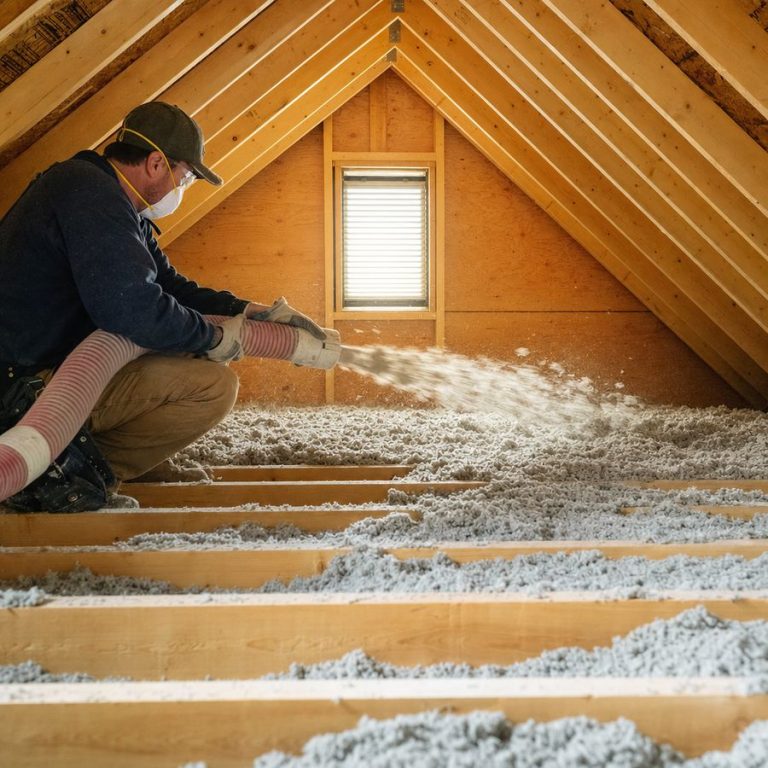
Material selection for commercial applications prioritizes durability, fire resistance, and thermal performance. Blown-in fibreglass insulation meets most commercial fire ratings while providing excellent R-value per inch. Formaldehyde-free products improve indoor air quality, particularly important for occupied buildings where HVAC systems may circulate air from attic spaces through building ventilation systems.
Quality assurance processes include mid-installation inspections, verification of uniform coverage, and final building inspector approval before occupancy. Municipal inspectors verify insulation depth meets specifications, ventilation clearances prevent moisture issues, and fire-stop integrity maintains building compartmentalization. Professional contractors coordinate with building inspectors to schedule required inspections and address any concerns promptly, working within the timelines commercial projects demand.
Maximizing Financing Benefits With Energy Upgrades
Property owners maximizing financing benefits often bundle attic insulation with complementary energy improvements. Combining roof insulation for commercial buildings with air-sealing, window upgrades, and HVAC improvements generates greater energy savings than isolated interventions, according to building energy modelling data from commercial retrofit projects.
Energy modelling using HOT2000 or eQUEST software identifies the highest-impact improvements through building performance simulations. Models reveal that combined air-sealing and insulation upgrades deliver 40-60% greater savings than insulation alone by addressing both conductive heat loss and infiltration losses.
Long-term energy management strategies include:
- Establishing maintenance schedules to address roof leaks promptly
- Monitoring ventilation system performance through annual inspections
- Conducting periodic thermal imaging surveys to identify degraded areas
- Implementing systematic energy management to reduce consumption over time
Energy-efficiency rebates in Alberta continue evolving as governments respond to climate targets. Property owners investing in insulation today position buildings to meet anticipated future requirements while capturing available financing. The federal government’s 2030 emissions reduction targets will likely drive more aggressive commercial building efficiency standards.
Future-proofing against increasing energy costs protects long-term property values and operational budgets. Natural gas and electricity prices historically increase faster than general inflation rates. Insulation improvements made today continue delivering savings for 20-30 years, with returns improving as energy costs rise.

Eco Attic Solutions Inc.: Secure Your Energy Future Today
Alberta commercial property owners have access to various municipal financing programs that can help offset the costs of attic insulation upgrades. While navigating program requirements and application processes requires working directly with municipal administrators and certified energy advisors, the potential for energy savings and operational cost reductions makes these improvements worth investigating.
Property owners considering insulation upgrades, whether through municipal financing programs or direct investment, face important decisions about commercial insulation contractor selection, material specifications, and building code compliance. Working with experienced contractors who understand commercial building requirements helps ensure installations meet performance standards and deliver expected energy efficiency improvements.
Eco Attic Solutions Inc. provides:
- Professional commercial attic insulation installations in Alberta for small-to-medium commercial properties in Calgary and surrounding areas
- Code-compliant work meeting Alberta Building Code standards for commercial applications
- Installation documentation suitable for building inspections and permit requirements
- Experience with commercial insulation projects in office buildings, retail spaces, and similar property types
Contact our commercial insulation team at (403) 990-9033 or email admin@ecoatticsolutions.com to discuss your commercial building’s insulation needs. Click on our contact page to schedule a consultation and learn more about professional insulation services for your property. For information about municipal energy efficiency financing programs, property owners should contact their local municipal program office or visit the Alberta Municipalities CEIP website directly.