If your Calgary home was built before 1990, you may have purchased one of the city’s most charming older neighbourhoods — Brentwood, Varsity, Ranchlands, Marlborough, Huntington Hills — complete with mature trees, wide lots, and an attic that has been quietly costing you money for decades. Pre-1990s homes across Calgary were built to insulation standards considered adequate at the time but that fall dramatically short of what the National Building Code Alberta Edition now requires. Some contain materials that weren’t just inadequate — they may be hazardous. Before you book any insulation work on an older home, here is what you absolutely need to know.
Quick Answer
Older Calgary homes built before 1990 typically have attic insulation well below the required R-60, and some contain vermiculite that may be contaminated with asbestos from the Libby, Montana mine. A professional inspection before any work is essential. Safe removal and replacement can dramatically cut heating costs and bring your home up to Alberta’s current building code standard.
Why Pre-1990s Calgary Homes Are a Special Case for Attic Insulation
Calgary’s building boom of the 1960s through the 1980s created thousands of well-built homes — but built to energy standards that were dramatically different. The National Building Code’s requirement for R-60 (RSI 10.43) in attic ceilings reflects updated energy modelling that accounts for the true cost of heat loss in a Climate Zone 7A city with -30°C cold snaps and furnaces that run almost continuously through January and February. Homes built in 1970 were often insulated to R-11 or R-12. Homes from the late 1970s might have R-20. Even homes from the late 1980s may top out at R-28 to R-32 — less than half of what Alberta’s code now demands.
The gap between code-required R-60 and a typical pre-1990s home’s R-11 to R-20 is enormous in practical terms. Think of it this way: your attic insulation is the thermal blanket over your entire living space. An older Calgary home going into a Zone 7A winter with R-12 insulation is like wearing a cotton sheet instead of a winter parka. The furnace runs almost constantly trying to compensate, utility bills climb, and upper floors remain uncomfortably cold no matter what the thermostat says. Upgrading from R-12 to R-60 typically cuts heating costs by 20–40% in Calgary homes that were severely under-insulated — and the payback period on a quality upgrade is often just three to five years.
But before any upgrade can happen in a pre-1990s home, the existing insulation must be identified and assessed — because some of what is up there may require specialized handling. This is not a project for a quick weekend DIY job. It is a professional assessment first, then an upgrade. Done in the right order, this is a straightforward, high-value home improvement. Done wrong, it can create health and safety hazards.
Could Your Calgary Home Contain Vermiculite (Asbestos) Insulation?
If your Calgary home was built or significantly renovated between roughly 1950 and 1990, there is a real possibility the attic contains vermiculite insulation — and if it does, it may be contaminated with asbestos. Vermiculite is a silver-grey, pebble-like mineral that was widely used as attic insulation under the brand name Zonolite Attic Insulation. It was approved for use in Canadian residential buildings for decades and was actively promoted through Canada’s Home Insulation Program (CHIP) in the late 1970s and early 1980s.
The problem is that a significant percentage of the vermiculite used in Canadian homes was mined at Libby, Montana — a deposit owned and operated by W.R. Grace that has since been confirmed to contain naturally occurring tremolite asbestos. Health Canada advises that vermiculite insulation should be treated as if it contains asbestos unless laboratory testing specifically confirms otherwise. The fibers are tiny, lightweight, and easily airborne when disturbed — meaning that even walking through the attic, cutting into ceilings, or running new wiring above a vermiculite-insulated attic floor can release fibers into living spaces below.
You can recognize vermiculite by its appearance: small, light, accordion-shaped grey or silvery-brown pebbles, typically 5–20 mm across, poured loosely between attic joists. It does not look like modern fiberglass (pink or yellow fluffy material), cellulose (grey, paper-like loose fill), or batt insulation (flat rectangular panels). If you see anything matching this description in your attic, do not disturb it — seal the access hatch and call a professional. A certified asbestos abatement contractor can take samples for laboratory analysis, and if asbestos is confirmed, regulated removal must happen before any insulation upgrade proceeds. Canadian Home Inspection Services provides a detailed guide on identifying vermiculite and the steps homeowners should take next.
What Other Insulation Types Are Common in Pre-1990s Calgary Attics?
Not every older Calgary home has vermiculite. Depending on when your home was built and whether any retrofits were done, you may find several different materials when you open the attic hatch:
- Fiberglass batts: Pink or yellow rectangular panels fitted between joists. Common from the 1960s onward. They compress, sag, and lose R-value over time; a 50-year-old R-11 fiberglass batt may now perform at R-7 or less due to settling and moisture exposure.
- Blown-in fiberglass: Loose white or pale yellow material. Also loses R-value with age and settling. Often added over original batts during 1970s–80s energy retrofits under federal or provincial programs.
- Blown-in cellulose: Grey, paper-like loose fill made from recycled newspaper. Sometimes installed during the CHIP program era. Can be in good condition or badly degraded depending on moisture history.
- Rock wool (mineral wool): Grey or brown fibrous material, denser than fiberglass. Common in 1940s–1960s construction. Still functional if undamaged, but nearly always well below R-60 in older applications.
- Vermiculite: As described above. Requires professional testing before any work is undertaken.
Identifying exactly what you have before proceeding is not optional — it determines whether a simple top-up is appropriate, whether full attic insulation removal is required, and whether specialized abatement must come first. Skipping this step in an older home is where serious problems originate.
Knob-and-Tube Wiring: A Fire Safety Issue You Must Resolve Before Insulating
Pre-1960s Calgary homes — and some from the early 1960s — may have knob-and-tube (K&T) wiring running through the attic. This older electrical system uses single-conductor wires strung through ceramic knobs and tubes, run in open air. That phrase — open air — is critical. Knob-and-tube was designed specifically to dissipate heat through air circulation around the bare conductors. The system works as long as that air gap is maintained.
When you pour or blow loose-fill insulation over knob-and-tube wiring, you eliminate the air gap the system depends on. Heat accumulates in the conductors, the aged rubber insulation on the wires degrades, and in a worst-case scenario the surrounding insulation material ignites. The Alberta Electrical Code prohibits burying active knob-and-tube wiring under insulation for precisely this reason. If your pre-1960s Calgary home has active K&T wiring in the attic, a licensed electrician must assess and address it before any insulation upgrade proceeds.
This is not a reason to avoid the upgrade — it’s a reason to do it in the correct order. Electrician first, insulation second. Many Calgary homeowners find that tackling both projects together makes financial sense: the electrical upgrade improves home safety and insurability (many Alberta insurers charge significantly higher premiums for homes with active K&T wiring, or refuse coverage altogether), while the insulation upgrade begins paying back in lower energy bills immediately. See our comparison of DIY vs. professional attic insulation to understand why older homes especially benefit from expert assessment and installation.
What R-Value Did Older Calgary Homes Get — and How Far Short Do They Fall?
The gap between historical and current insulation standards in Calgary is striking when you lay them side by side. The table below shows how attic insulation requirements evolved over time in Alberta’s building code — and what a typical older Calgary home still needs to reach today’s R-60 standard:
| Era Built | Approximate Original Attic R-Value | Additional R-Value Needed for R-60 |
|---|---|---|
| Pre-1965 | R-11 or less | Needs ~R-49 added |
| 1965–1975 | R-11 to R-20 | Needs R-40–R-49 added |
| 1976–1985 | R-20 to R-28 | Needs R-32–R-40 added |
| 1986–1995 | R-28 to R-32 | Needs R-28–R-32 added |
| Current code | R-60 (RSI 10.43) | — |
According to Natural Resources Canada’s “Keeping the Heat In” guide, the attic is typically where the largest insulation improvements can be made in an existing Canadian home — and where you get the highest return on investment relative to cost. In an older Calgary home, upgrading from R-11 to R-60 can reduce attic-related heat loss by more than 80%. That improvement translates directly into lower natural gas bills every single month for the life of the upgrade — which, with quality materials and professional installation, can be 25–40 years. For context on how long insulation typically lasts, see our article on how often to replace attic insulation in Calgary homes.
Is a Top-Up Enough, or Does Old Insulation Need to Be Removed?
This is one of the most common questions Calgary homeowners ask when planning an upgrade on an older home. The answer depends on the condition of what’s already up there. If your older home has fiberglass batts or blown-in cellulose that is dry, undamaged, free of mould or pest contamination, and has not been significantly compressed or soaked, topping up with new blown-in material over the existing layer is often a viable and cost-effective approach. You would simply add enough new material to bring the total depth to the R-60 equivalent — roughly 16 inches of blown-in fiberglass or 22 inches of blown-in cellulose, depending on the product.
However, removal is necessary — and the smarter investment — when the existing insulation has been damaged by moisture, compromised by rodents or insects, or is a material that cannot safely be buried (vermiculite being the most urgent example). Moisture-damaged insulation not only provides minimal R-value; it can harbour mould spores that circulate into living spaces. A full removal clears the attic to a clean slate, allows comprehensive air sealing of all ceiling penetrations, and ensures the new material sits without performance-robbing gaps or compressed areas. Our professional attic insulation removal service includes vacuum extraction, clean-up, and proper disposal, leaving the attic completely ready for the upgrade.
The Safe Step-by-Step Process for Upgrading an Older Calgary Home’s Attic Insulation
Given all of the above, upgrading an older Calgary home’s attic insulation is manageable and highly rewarding — but it requires the right sequence to be safe and effective:
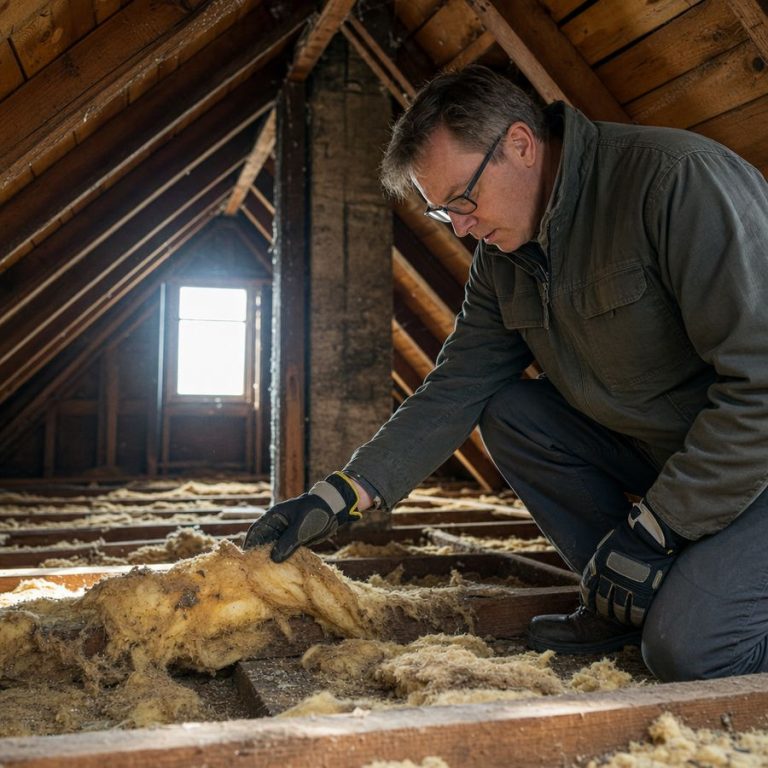
- Step 1: Visual inspection. Look at the attic to identify the insulation type, check for vermiculite (do not disturb), note any moisture staining, mould, or pest evidence, and observe current depth and coverage.
- Step 2: Test if vermiculite is present. A certified abatement contractor takes samples for laboratory asbestos analysis. Do not disturb vermiculite yourself under any circumstances.
- Step 3: Electrical assessment. If the home is pre-1965, have a licensed electrician confirm whether active K&T wiring runs through the attic space.
- Step 4: Remediation if needed. Asbestos abatement and/or electrical upgrades completed by licensed professionals before insulation work begins.
- Step 5: Professional insulation removal if needed. Damaged, contaminated, or hazardous insulation is vacuum-extracted and disposed of in accordance with Alberta regulations.
- Step 6: Air sealing. All penetrations — pot lights, plumbing stacks, attic hatches, chimneys — are sealed with appropriate materials before new insulation is installed. This step alone can reduce energy loss by 20–30%.
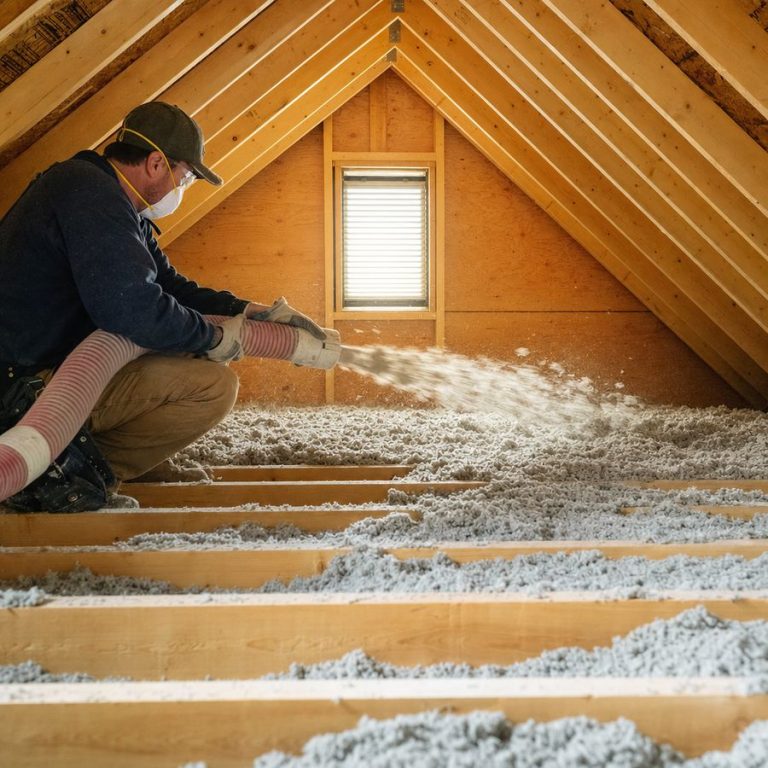
- Step 7: New insulation installation. Blown-in cellulose or fiberglass is installed to achieve R-60, ensuring complete and even coverage from wall plate to wall plate.
A qualified Calgary insulation contractor coordinates and assesses all of these steps in sequence so nothing is missed. For details on what our installation process looks like, see our page on residential attic insulation upgrades in Calgary.
Frequently Asked Questions
How do I know if my older Calgary home has vermiculite insulation?
Vermiculite looks like small, lightweight, accordion-shaped grey or silvery-brown pebbles, typically poured loose between attic joists. It does not look like fluffy fiberglass (pink or yellow) or grey paper-like cellulose. If you see this material in your Calgary attic, do not disturb it — seal the hatch and contact a certified abatement professional to take samples for asbestos testing before any work proceeds.
Is it safe to add insulation over old fiberglass batts in my older Calgary home?
Yes, in most cases, provided the existing batts are dry and undamaged. Topping up with blown-in insulation over dry, intact fiberglass batts is a common and cost-effective approach in older Calgary homes. However, if batts show moisture damage, mould, pest contamination, or significant compression, full removal is recommended before new insulation is installed to ensure maximum performance and healthy indoor air.
What R-value does a pre-1990 Calgary home typically have, and how much is needed?
Pre-1980 Calgary homes commonly have attic insulation from R-11 to R-20, far below Alberta’s current Building Code requirement of R-60. A home with R-12 may need approximately R-48 of new material added. Upgrading from R-11 to R-60 can reduce attic-related heat loss by over 80% and significantly lower monthly natural gas bills in Calgary’s Climate Zone 7A climate.
Can I insulate my older Calgary attic myself without a professional?
We strongly recommend against DIY insulation in pre-1990 Calgary homes without a professional assessment first. The risks are specific: disturbing vermiculite without testing it for asbestos, covering active knob-and-tube wiring, or missing critical air sealing bypasses that older homes commonly have. A professional assessment with Eco Attic Solutions is free and can prevent serious health and safety issues before they occur.
How long does attic insulation upgrade take in an older Calgary home?
A straightforward top-up is typically completed in one day. Full removal and reinstallation takes one to two days for removal plus one day for installation. If asbestos abatement or electrical work is required first, those projects have their own timelines — typically one to three days each. A free professional assessment will give you a clear picture of the full scope and timeline before you commit.
How Eco Attic Solutions Helps Calgary Homeowners Upgrade Older Homes Safely
Older Calgary homes are exactly where a professional assessment makes the biggest difference — and we have completed safe, high-quality attic insulation upgrades in hundreds of them across the city. With 780+ Calgary customers, our team knows the older neighbourhoods, the original construction methods, and the specific insulation challenges that pre-1990s homes present. We have seen the vermiculite, coordinated the K&T wiring handoffs with licensed electricians, and navigated every scenario that older Calgary attics throw at us.
Every job starts with a free, no-obligation site assessment that identifies exactly what is in your attic, what needs to happen before insulation work can begin, and what R-value upgrade will bring you to Alberta’s current R-60 standard. Our eco-friendly blown-in materials are safe for your family and the environment, and every project is backed by our 12-Month Workmanship Guarantee — if anything is not right, we make it right at no cost to you. We also offer flexible financing with up to 6 months deferred payment, so even a multi-step project that includes removal and air sealing stays financially accessible.
Don’t let an older home drain your budget through the ceiling year after year. Contact Eco Attic Solutions online or call (403) 990-9033 for your free assessment today. We’ll guide you through every step — from inspection to completion — safely, professionally, and on your schedule.