One day it’s −25°C and your furnace is running flat out. Then a Chinook rolls in overnight and by morning you’re looking at +10°C. It feels like a gift. But inside your attic, something damaging is quietly happening — and most Calgary homeowners have no idea. Every time a Chinook swings through, the dramatic temperature shift triggers a cycle of freezing, thawing, condensation, and refreezing that gradually breaks down your attic insulation, drives up your energy bills, and can eventually cause water damage, mould, and structural problems in your home.
Calgary’s Climate Zone 7A designation means your attic insulation is working harder than almost anywhere else in North America. And while Calgary’s winters are infamous for their cold snaps, it’s actually the temperature swings — not just the cold — that create the greatest threat to your home’s thermal envelope. This article explains exactly how Chinooks damage your attic insulation, what the warning signs look like, and how to protect your home with the right sequence of upgrades.
What Are Calgary Chinook Winds — and How Extreme Are They?
Chinook winds are warm, dry air currents that descend the eastern slopes of the Rocky Mountains into southern Alberta. As moist Pacific air rises over British Columbia’s mountains, it loses its moisture through precipitation on the windward side. On the eastern (leeward) side, that same air descends and warms at roughly 10°C per 1,000 metres of descent, arriving in Calgary as a warm, dry wind that can come within hours. According to The Canadian Encyclopedia, Chinook events can raise temperatures by 20–30°C within just a few hours — and Calgary experiences 30 to 35 Chinook days per year, with approximately 25 of those occurring during the core winter months of December through February. That works out to roughly one Chinook event every three to four winter days.
The practical reality is dramatic. Weather records document temperature swings of +22°C followed by a crash of −22°C within a single day in southern Alberta. In Calgary, swings from −20°C to +10°C overnight are common enough that most residents don’t think twice about them. But your attic does. Those swings represent exactly the kind of mechanical stress — repeated expansion, contraction, moisture cycling, and freezing — that no building material was designed to handle this many times per year. Calgary in fact experiences approximately 128 freeze-thaw cycles annually across the full calendar year, and climate projections suggest that number will rise to 18.5 cycles per winter by 2050 as Chinooks become more frequent.
How Chinooks Create “Attic Rain” — Calgary’s Hidden Moisture Problem
To understand the damage, you need to understand how moisture moves through a Calgary home in winter. Warm interior air carries moisture from cooking, showers, breathing, and humidifiers. Because warm air rises, this moisture migrates upward through the stack effect and finds its way into the attic through tiny gaps: recessed light fixtures, plumbing penetrations, electrical boxes, attic hatches, and any imperfection in the vapour barrier. Once inside the cold attic, that warm, moist air hits surfaces well below the dew point and immediately condenses — then freezes, building up layers of frost on the roof decking, trusses, and rafters during Calgary’s extended cold snaps.
Then the Chinook arrives. Outdoor temperatures spike 20–30°C in hours. All that accumulated attic frost melts rapidly — far faster than soffit and ridge vents can manage. The resulting liquid water cascades down through the same ceiling penetrations it entered as vapour, dripping through pot lights, bathroom fans, drywall seams, and ceiling fixtures. Homeowners routinely mistake this for a roof leak. This phenomenon is known as “attic rain,” and Calgary’s Chinook frequency makes it more common here than virtually anywhere else in Canada. Natural Resources Canada’s Keeping the Heat In guide (Section 5: Roofs and Attics) specifically identifies this condensation cycle as a primary risk in Canada’s colder climate zones and notes that frost buildup of 10mm or more in an attic warrants immediate professional investigation.
Warning signs to look for after Chinook events include new water stains on ceilings or around pot lights, dripping from bathroom exhaust fans, musty odours in upper rooms, visible condensation streaks on walls near the attic hatch, and unexplained spikes in heating bills. If you notice any of these following a major Chinook swing, don’t wait — the damage compounds with each subsequent cycle. Learning how to identify these signs early is one reason we always recommend reading our overview of how often Calgary homes need insulation replacement.
How Freeze-Thaw Cycling Gradually Destroys Attic Insulation
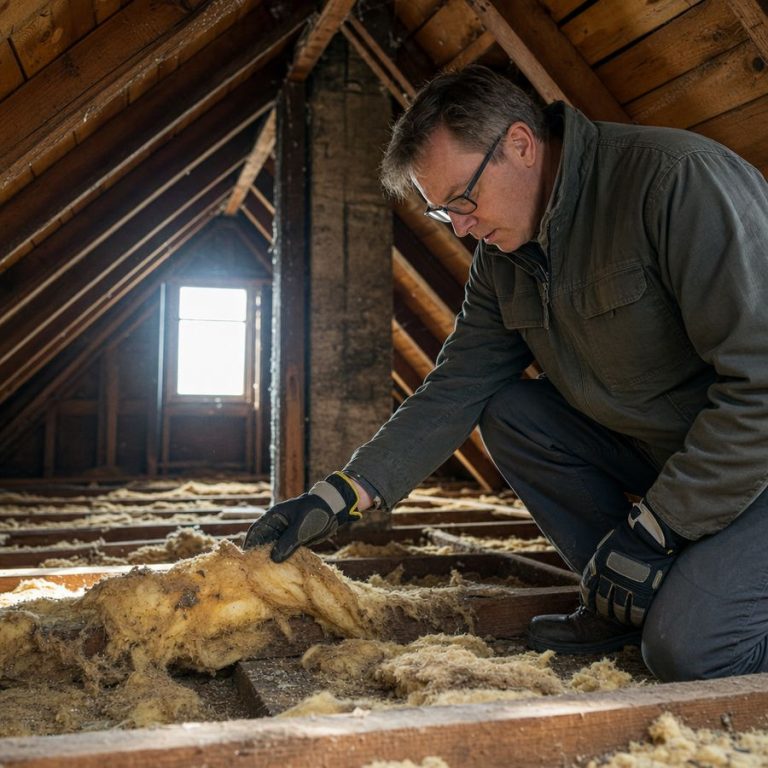
Calgary experiences approximately 16.2 freeze-thaw cycles per meteorological winter — defined as consecutive days above 0°C followed by days below 0°C. Each cycle introduces moisture into attic insulation, and the cumulative effect is destructive in ways that aren’t visible from below. Fibrous insulation materials like fibreglass batts and loose-fill cellulose absorb moisture when wet conditions persist. As the water in the insulation fibres freezes, it expands microscopically; when it thaws, it collapses. After dozens or hundreds of such cycles, the insulation physically compacts under its own weight, losing the trapped air pockets that are the actual source of its R-value.
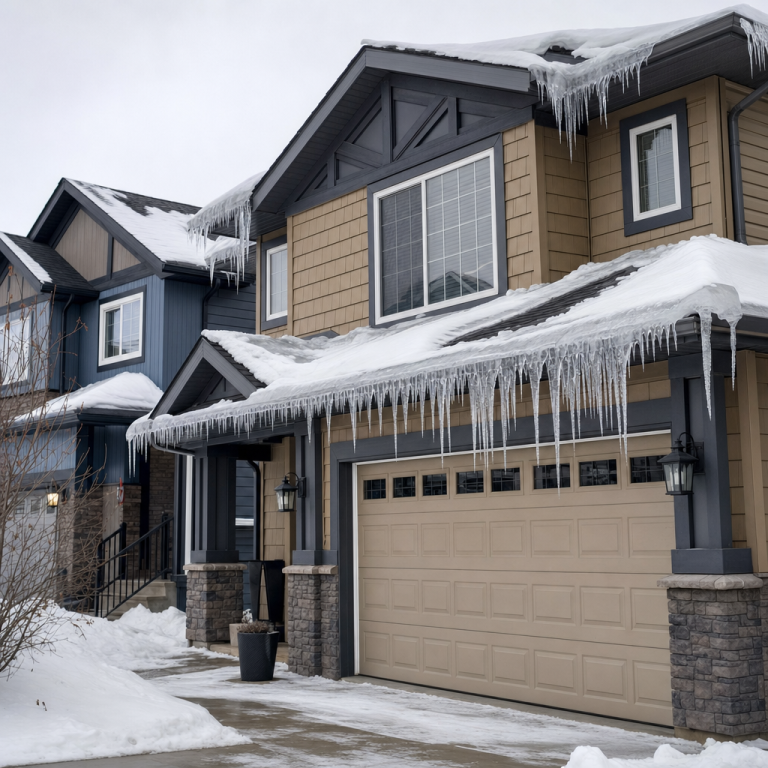
Industry data from the Calgary market suggests that many homes are performing at 20–40% below their originally installed R-values as a result of this compaction and moisture cycling. A home insulated to R-40 in 1995 may be effectively delivering only R-24 to R-32 today — and a home insulated to R-20 in 1980 may be down to R-12 or lower. That gap costs money every single month. Beyond compaction, persistent moisture creates conditions for mould growth on wood framing, trusses, and roof decking. Ice damming is another consequence: when degraded insulation allows warm patches to develop unevenly on the roof deck, snow melts in those zones, runs toward the cold eaves, and refreezes, forming dams that back water under shingles and into the structure.
The City of Calgary’s Climate Ready Measures page on insulation notes that upgrading to the code-required R-60 is one of the most impactful actions Calgary homeowners can take to reduce both energy costs and the risk of this kind of moisture-related damage. And understanding what’s happening inside that attic — before problems become visible downstairs — starts with knowing what to look for.
The R-60 Standard Calgary Requires — And Why Most Homes Fall Short
Calgary’s Climate Zone 7A designation under the National Building Code — Alberta Edition mandates a minimum attic insulation level of RSI 10.43 (R-60) for residential ceilings below attics. R-60 is a high target: it means approximately 16 to 20 inches of blown-in fibreglass insulation covering every square foot of attic floor, with no cold spots, gaps, or compression. Most homes built before 2000 in Calgary contain only R-20 to R-30 in their attics. Homes from the 1970s and 1980s may have as little as R-12 — a massive gap that every Chinook-driven freeze-thaw cycle exploits.
Upgrading from R-20 to R-60 isn’t just a code compliance exercise. It delivers real financial returns. Proper R-60 insulation can reduce annual heating costs by approximately $455 for a typical Calgary home, and air leakage alone — separate from the insulation itself — can account for up to 30% of total heating and cooling costs. That means a home with decent insulation but poor air sealing is still hemorrhaging money through every cold snap and Chinook cycle. The City of Calgary and Natural Resources Canada both affirm that homeowners should “do that and more” beyond the code minimum, particularly for older homes where existing insulation has years of freeze-thaw cycling already built in.
If you want to check your own attic: bring a ruler and a flashlight. Measure the depth of insulation in several spots, including near the outer edges above exterior walls — the most commonly under-insulated zone. Blown-in fibreglass reaches R-60 at approximately 16–18 inches of depth; fibreglass batts at roughly 19–20 inches. If you’re at 8 inches or under, you’re likely performing at R-20 or below — well short of both the code and the protection your home needs against Calgary’s Chinook-driven extremes. Our guide to blown-in insulation vs. batts for Calgary homes explains the material options in detail.
What You Can Do: A Calgary Homeowner’s Action Plan
Step 1: Air Sealing — Do This Before Adding Insulation
Natural Resources Canada is unequivocal on this point: “The importance of air sealing cannot be overstated.” Sealing the air pathways that let warm, moist air into the attic in the first place is the single most effective intervention — and it must happen before adding insulation, not after. Adding insulation on top of an unaddressed air leakage problem simply pushes the condensation point deeper into the attic structure, making it harder to detect and more damaging over time.
The critical sealing locations in Calgary homes are recessed pot lights (one of the largest sources of attic air leakage in homes built before 2005), bathroom exhaust fans, plumbing stack penetrations, electrical boxes, and the attic hatch itself. The attic hatch deserves special attention: an uninsulated hatch is effectively a large, open window to your attic. It should be weatherstripped on all four sides and have rigid foam insulation attached to the back face, bringing it to at least R-20. Exhaust fans should be confirmed to vent directly to the exterior — not into the attic space. A bathroom fan discharging into the attic is one of the most common triggers of attic frost and attic rain in Calgary homes. The connection between air sealing and energy bill savings is explored in detail in our guide on how insulation upgrades lower Calgary energy bills.
Step 2: Upgrade Attic Insulation to R-60
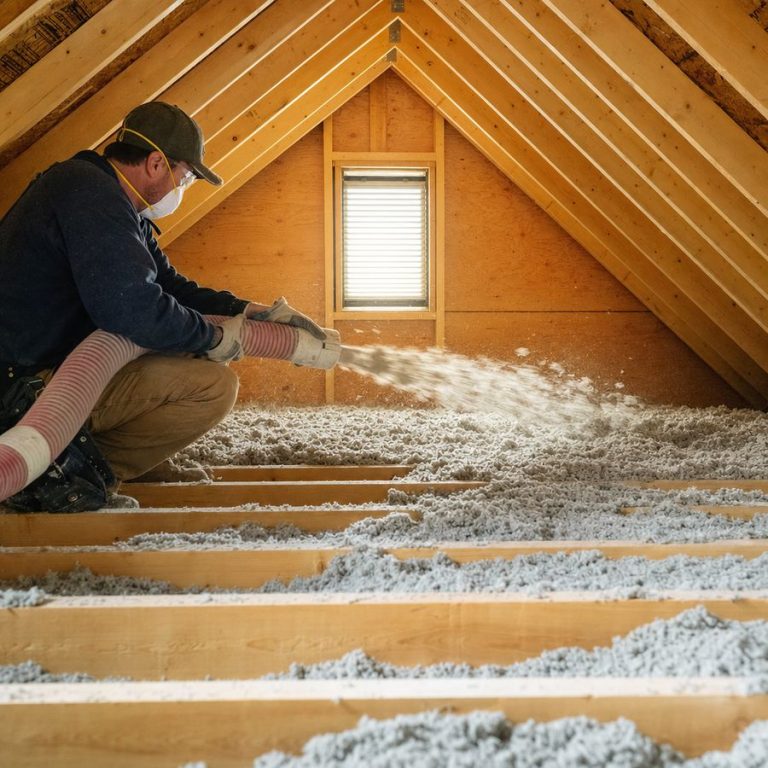
Once air sealing is complete, the next step is bringing attic insulation up to R-60. For most Calgary retrofits, blown-in loose-fill fibreglass is the most practical choice: it installs quickly, fills irregular joist bays and around obstacles without gaps, does not absorb moisture the way cellulose does, and reaches the required depth efficiently. Whatever material is selected, depth markers — ruler stakes installed every few feet across the attic floor — should be used to verify consistent depth at every point, including the critical outer edges above exterior walls where cold bridging is most severe.
Step 3: Ensure Balanced Attic Ventilation
Proper ventilation is what allows the attic to flush moisture before it condenses. Natural Resources Canada specifies a minimum ventilation ratio of 1:300 — one square foot of unobstructed vent area for every 300 square feet of insulated ceiling — with roughly equal split between soffit (intake) vents and ridge or roof (exhaust) vents. Before adding any insulation, rafter baffles must be installed at every soffit opening to maintain a clear airflow channel from soffit to ridge. If baffles are missing or soffits are blocked, new insulation will trap moisture in the attic rather than allowing it to exhaust. Our dedicated attic ventilation service addresses exactly this issue as part of a complete attic upgrade.
Step 4: Chinook-Specific Seasonal Vigilance
Beyond major upgrade work, Calgary homeowners should build Chinook-aware habits into their seasonal routine. Before and during cold snaps, reduce indoor humidity proactively: lower humidifier settings, run exhaust fans consistently during showers and cooking, and limit high-steam activities when temperatures are well below freezing. After every major Chinook event — especially when temperatures swing more than 15°C in a day — inspect your ceilings for new stains, check around pot lights and bathroom fans for any sign of moisture, and note whether musty odours emerge in the days following. Early detection of attic moisture prevents the compounding damage that turns a minor condensation issue into a mould problem requiring full insulation removal and replacement.
How Eco Attic Solutions Helps Calgary Homeowners Fight the Chinook Cycle
At Eco Attic Solutions, we specialize in exactly this challenge. Our team understands Calgary’s unique Climate Zone 7A conditions, the Chinook-driven freeze-thaw cycle, and the correct sequence of air sealing, insulation, and ventilation work that protects homes against it. With over 780 customers served across Calgary and a 12-Month Workmanship Guarantee on all our work, we don’t just install insulation — we address the full picture of what makes attic insulation perform in this climate.
We offer free, no-obligation quotes, eco-friendly insulation materials, and flexible financing with up to 6 months deferred payment — making it easy to take action before the next Chinook season puts your attic to the test. Whether your home needs a complete residential attic insulation upgrade, ventilation improvements, or a full insulation removal and fresh start, our team has the experience and equipment to do it right the first time. Don’t wait for the next Chinook to show you what your attic can’t handle. Call us at (403) 990-9033 or request your free quote online today.