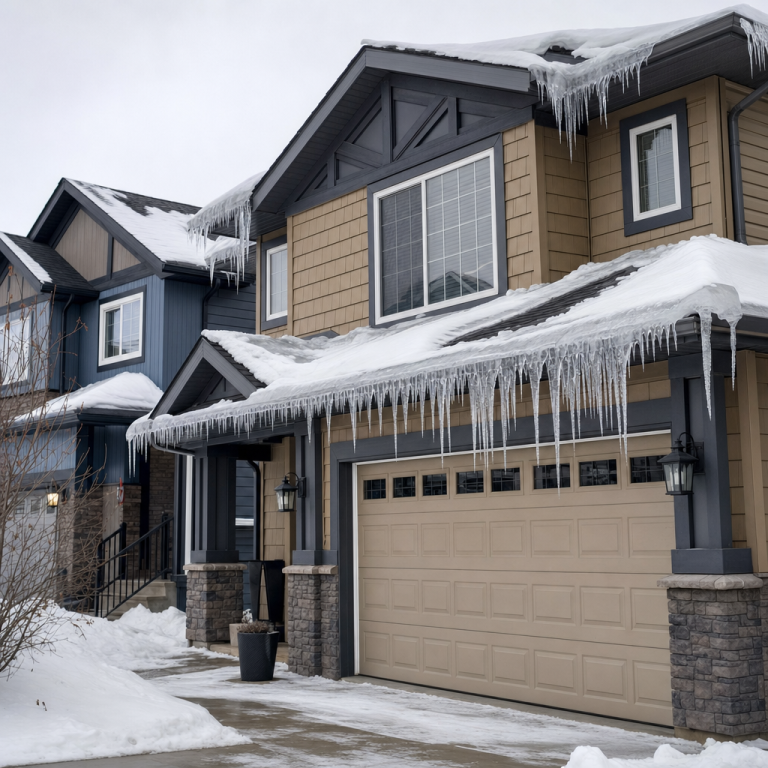
Every Calgary winter, thousands of attics silently suffer a problem most homeowners never see until it becomes expensive: moisture. Warm, humid air from your kitchen, bathrooms, and living spaces rises, finds its way through tiny gaps in your ceiling, and hits the cold attic space above—where it freezes onto roof sheathing, nails, and insulation. When the Chinook arrives and temperatures climb 15–20°C within hours, that frost melts rapidly, saturating insulation and soaking wood that has nowhere to drain. That phenomenon is “attic rain”—and a properly installed vapor barrier is your first line of defence against it.
Quick Answer
In Calgary’s Climate Zone 7A, a continuous 6-mil polyethylene vapor barrier on the warm (interior) side of attic insulation is required by the Alberta Building Code. Without it, warm indoor air penetrates the ceiling, freezes on cold sheathing in winter, and melts during Chinooks—causing mold, compressed insulation, and costly rot. Older Calgary homes frequently have failed or missing barriers.
What Is an Attic Vapor Barrier and Why Does Calgary’s Climate Make It Critical?
A vapor barrier—technically a vapor retarder—is a layer of material, almost always 6-mil (0.15 mm) polyethylene sheeting in Alberta construction, installed on the warm side of your attic insulation facing down toward your living space. Its job is to dramatically slow the movement of water vapor from inside your home into the cold attic above. In Calgary’s Climate Zone 7A, where indoor-outdoor temperature differences can exceed 50°C in deep winter, vapor pressure gradients are extreme. Without a properly sealed barrier, moisture migration through the ceiling is relentless and cumulative.
The physics are straightforward: warm air holds far more moisture than cold air. As heated indoor air rises toward your ceiling, it carries humidity from cooking, breathing, showering, and even houseplants. When that moist air contacts a cold attic surface—which in a Calgary attic at -25°C happens almost immediately—it condenses or freezes. Natural Resources Canada’s Keeping the Heat In guide specifically identifies vapor barrier continuity as a critical factor in cold-climate attic performance, noting that even small gaps in the barrier can allow significant moisture transfer under Alberta-level temperature differentials.
What makes Calgary uniquely challenging is the Chinook effect. While other Prairie cities face sustained deep cold, Calgary homeowners deal with rapid, dramatic temperature swings—sometimes 20°C in 24 hours—that cause accumulated attic frost to melt almost explosively. This freeze-thaw cycling is one of the most damaging patterns an attic can experience. Frost that took weeks to accumulate can melt in an afternoon, saturating insulation before it can dry. This cycle is almost entirely preventable with a properly sealed vapor barrier combined with adequate attic ventilation—but when either element is missing, the damage compounds year after year.
What Happens When a Vapor Barrier Fails or Is Missing in a Calgary Attic?
The consequences of a failed or missing vapor barrier range from reduced energy efficiency at the mild end to severe structural damage and health hazards at the serious end. Most Calgary homeowners don’t discover the problem until a home inspection uncovers it, a visible mold patch appears on a ceiling, or water stains emerge after a Chinook warm spell—by which point significant damage may already have occurred across multiple heating seasons.
When warm air bypasses a broken or missing barrier and enters the attic, damage follows a predictable sequence. First, moisture accumulates in the insulation. Wet insulation doesn’t insulate—fibreglass batts that are saturated with moisture can lose 30–40% of their rated R-value. What started as R-40 insulation may be performing at R-25 or worse. Next, frost builds on the underside of the roof sheathing and on roofing nails—a phenomenon so common in Alberta that it has its own name: “attic frost” or “attic rain.” When that frost melts during a Chinook, the water soaks into wood sheathing, creating ideal conditions for mold. Stachybotrys (black mold) and other species can establish themselves on saturated wood within 24–48 hours. Left untreated, the result is compromised structural integrity, failed insulation requiring full removal and replacement, a mold remediation project, and potential sheathing replacement—repairs that can cost $10,000–$30,000 or more depending on the extent of damage.
The problem is compounded by bathroom exhaust fans or kitchen range hoods that vent into the attic rather than out through the roof—a code violation that remains common in older Calgary homes. These ducts introduce concentrated warm humidity directly into a cold space, and represent one of the fastest ways to create catastrophic mold conditions regardless of insulation quality. If your home has any attic-terminating exhaust ducts, correcting them is urgent—more urgent, in fact, than almost any other attic upgrade. Our attic insulation removal and replacement service always includes an assessment of exhaust duct routing as a baseline step.
How Do I Know If My Calgary Home Has a Vapor Barrier Problem?
Some signs of vapor barrier failure are visible from inside your home without entering the attic. Watch for these warning indicators during and after cold snaps:
- Water stains or damp patches on ceilings after Chinook warm spells, especially near exterior walls or around pot lights
- Frost patterns visible on ceilings during very cold stretches, especially near the attic hatch
- Musty or mildew odours that concentrate near ceiling fixtures or in rooms directly under the attic
- Condensation on interior walls near the ceiling line on cold mornings
- Higher-than-expected energy bills, especially if the home is older and insulation has never been assessed
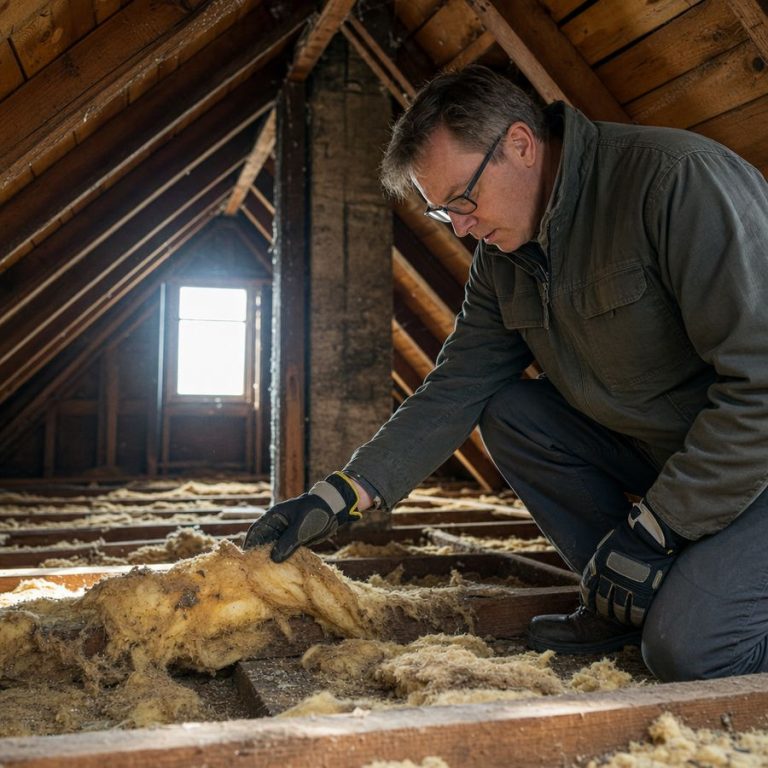
For a direct assessment, a qualified inspector or insulation contractor can enter the attic and check the following: whether a continuous polyethylene vapor barrier is present; whether it’s intact or torn, with gaps around pot lights, wiring, and penetrations; staining or grey/black discolouration on the underside of roof sheathing; rust or white deposits on roofing nails (indicating frost cycles); the condition and depth of the insulation itself; whether exhaust ducts terminate inside the attic; and whether soffit vents and ridge vents are clear and sized correctly. Our team at Eco Attic Solutions performs this kind of thorough assessment as part of every residential attic insulation upgrade.
If your home was built before 1990, the likelihood of an inadequate or failed vapor barrier is significantly higher. Many pre-1980 Calgary homes were built with wax paper or kraft-faced insulation as their only vapor retarder—materials that degraded decades ago. Even homes from the 1980s and early 1990s often used vapor barriers that were installed with insufficient sealing around penetrations, or that have since been punctured by later renovations. If you haven’t had your attic assessed and you’re living in a home from this era, it’s worth knowing what’s up there. See our overview of how often Calgary homes need insulation replacement for more context.
What Are Alberta’s Vapor Barrier Requirements for Attics?
The Alberta Building Code (based on the National Building Code of Canada) mandates a vapor barrier on the warm side of insulation in all Climate Zone 7 construction. Understanding these requirements helps homeowners recognize when their home may not meet current standards and what a proper installation should include:
- Material: 6-mil (0.15 mm) polyethylene sheeting is the standard. Some alternative products—reinforced poly, “smart” vapor retarders that adjust permeability with humidity—are permitted under specific engineering conditions, but standard 6-mil poly remains the most common choice for residential attics.
- Placement: On the warm (interior) side of the insulation, facing the conditioned living space. This is non-negotiable in Zone 7A—installing it on the cold side creates a moisture trap.
- Continuity: The barrier must be continuous across the entire ceiling plane, with overlapping joints lapped a minimum of 100 mm and sealed with rated vapor barrier tape or acoustical sealant at all penetrations.
- Penetrations: Every pot light, wiring chase, plumbing stack, exhaust duct, and attic hatch must be individually sealed. These penetrations are the most common source of vapor barrier failures in older Calgary homes.
- Attic hatch: Must be insulated and weatherstripped separately—the hatch itself is a significant weak point that many homes neglect entirely.
One critical nuance emphasized by both the Alberta Building Code and the Insulation Institute’s vapor retarder guidance: a vapor barrier alone is not sufficient. It must work in combination with air sealing. The vapor barrier limits diffusion of moisture through materials; air sealing stops the bulk movement of moist air through gaps and holes. Most Calgary attic moisture problems occur in homes where a vapor barrier is technically present but riddled with holes around pot lights, junction boxes, and other penetrations. For a deeper dive on why these two work together, see our article on why air sealing is as important as insulation.
How Is a Vapor Barrier Installed or Replaced in a Calgary Attic?
Installing or replacing an attic vapor barrier is not a straightforward DIY project for most homeowners. The work requires navigating a confined, often insulation-filled space, carefully fitting and sealing poly sheeting around every penetration, and ensuring proper lapping and taping at every seam—all while working in an uncomfortable environment in clothing that won’t shed fibres into the fresh insulation. Improper installation—even a few unsealed gaps around pot lights—can perform nearly as poorly as having no barrier at all, because bulk air movement through penetrations is responsible for far more moisture transfer than diffusion through intact material.
A professional installation typically follows this sequence:
- Assessment: Existing insulation depth, condition, and vapor barrier status are documented. Exhaust duct routing is verified.
- Removal (if needed): Damaged or contaminated insulation is extracted. If only the barrier needs replacement and existing insulation is in good condition, it may be carefully displaced and replaced.
- Air sealing: All ceiling penetrations—pot lights, wiring, plumbing, partition walls, chimney chases—are air-sealed with fire-rated caulk or spray foam before the vapor barrier goes in. This step is done first because it’s impossible to do properly once insulation is in place.
- Vapor barrier installation: 6-mil poly sheeting is installed continuously across the entire ceiling plane, overlapped and taped at seams, and sealed at every penetration with acoustical sealant or rated tape.
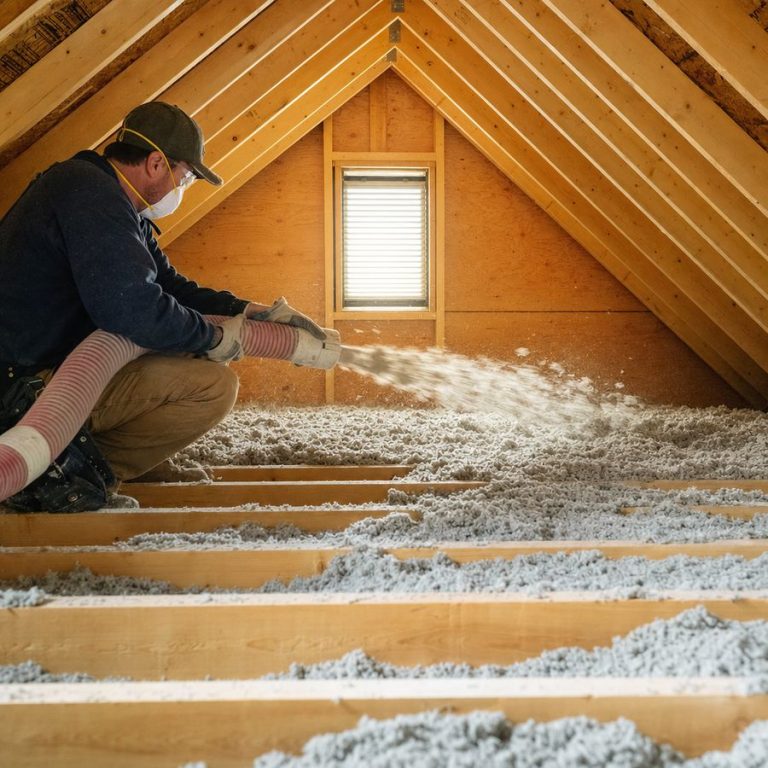
- Insulation installation: New insulation is installed to the required depth to achieve R-60 or greater throughout.
- Ventilation verification: Soffit vents, baffles, and ridge or roof vents are checked and corrected as needed to ensure the ventilated attic space above the insulation functions properly.
The combination of a new vapor barrier, thorough air sealing, full-depth R-60 insulation, and verified ventilation is the gold standard for Calgary attics—and it’s the integrated approach our team at Eco Attic Solutions brings to every job. You can review what to expect from our residential attic insulation service, or compare your options in our breakdown of blown-in insulation vs. batts for Calgary homes.
Frequently Asked Questions
Does my Calgary attic need a vapor barrier?
Yes. Alberta’s building code requires a vapor barrier in Climate Zone 7A, where Calgary is located. A continuous 6-mil polyethylene sheet installed on the warm (interior) side of the attic insulation is standard. Without it, warm indoor air penetrates the ceiling, freezes on the cold roof deck during winter, and melts during Chinooks—causing mold, rot, and insulation damage that compounds year over year.
What are the signs that my Calgary home’s vapor barrier has failed?
Common signs include water stains or frost patterns on ceilings after cold snaps, musty odours near ceiling fixtures or the attic hatch, condensation on interior walls near the ceiling line, and dark staining on attic sheathing visible during a professional inspection. Older Calgary homes built before 1980 are at highest risk and frequently have degraded or missing barriers.
How much does it cost to replace a vapor barrier in a Calgary attic?
Vapor barrier replacement is typically done as part of a full attic insulation upgrade in Calgary. Total project costs generally range from $3,000 to $7,000 depending on attic size, existing insulation removal needs, and the extent of air sealing required. Eco Attic Solutions provides free, no-obligation quotes and offers flexible financing with up to 6 months deferred.
Can I install an attic vapor barrier myself in Calgary?
It’s not recommended. A DIY vapor barrier installation that leaves gaps around pot lights, wiring, or other ceiling penetrations can perform nearly as poorly as having no barrier at all. Professional installation ensures every penetration is sealed, the sheeting is correctly lapped and taped, and ventilation is verified—critical in Calgary’s Chinook-affected climate where frost-melt cycles are common.
How does a vapor barrier prevent attic frost and attic rain in Calgary?
Attic frost forms when warm indoor air bypasses the ceiling and contacts cold attic surfaces. A properly sealed vapor barrier dramatically limits this airflow by stopping moisture-laden air before it reaches the cold sheathing. Paired with adequate ventilation, it prevents frost accumulation—and the “attic rain” events that follow when Calgary Chinooks raise temperatures 15–20°C within hours, melting accumulated frost and saturating insulation below.
How Eco Attic Solutions Helps Calgary Homeowners Protect Their Attic
Vapor barrier failures are among the most common—and most preventable—causes of attic damage in Calgary homes. Eco Attic Solutions has helped more than 780 Calgary homeowners assess and upgrade their attic insulation systems, including vapor barrier inspection and replacement as part of every comprehensive project. Our team uses eco-friendly materials, proven installation techniques, and always pairs insulation work with an air sealing assessment and ventilation check—because your attic performs as a system, and every element needs to work together.
Every project comes with our 12-Month Workmanship Guarantee, giving you confidence that the job is done right. We offer flexible financing with up to 6 months deferred so you can protect your home without delay. Whether your attic needs a complete overhaul or a targeted barrier and air sealing upgrade, we’ll give you an honest assessment and a clear, detailed quote. Request your free, no-obligation quote or call us at (403) 990-9033—and stop the moisture problem before it becomes a major repair bill.