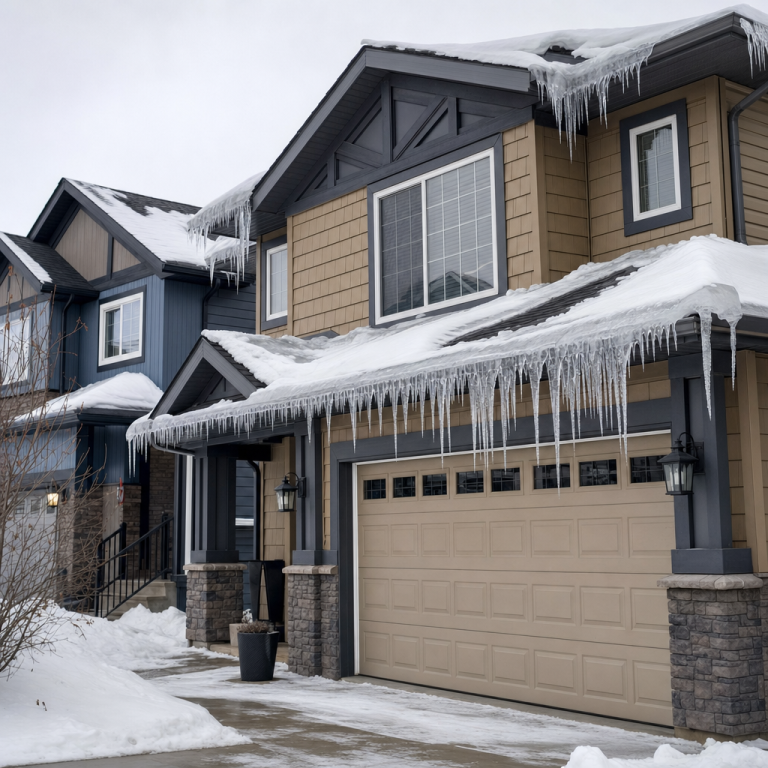
Every fall, as Calgary temperatures drop toward zero, something else starts looking for warmth — and it has four legs. Mice can squeeze through a gap as small as 6 mm. Squirrels tear open soffits. Raccoons pry back roof vents. Once inside your attic, they shred and compact your insulation to build nests, saturate it with urine and droppings, and gnaw through wiring hidden within the insulation material itself. By the time most Calgary homeowners notice — a scratching sound overhead, a spike in the gas bill, or a musky smell drifting down from the ceiling — the damage can already be extensive. And unlike most home maintenance problems, this one carries a health risk serious enough that Alberta Health has recorded deaths from it in the current decade.
Quick Answer
Mice, squirrels, raccoons, bats, and birds routinely damage Calgary attic insulation each fall, shredding and compressing material in ways that reduce effective R-value by 30–50% in affected areas. The health risk is serious — Alberta has recorded 81 hantavirus cases and 15 deaths since 1989. Professional removal and reinstallation is strongly recommended once infestation is confirmed.
Calgary’s harsh winters make the attic an irresistible destination for wildlife. Once inside, they do not merely share the space — they destroy it. This guide walks Calgary homeowners through the warning signs of pest-damaged insulation, the health risks involved, and exactly what to do when you discover the problem. The good news: with the right professional help, full removal, sanitization, and reinstallation can return your attic to code-compliant R-60 performance — and keep it that way.
What Pests Damage Attic Insulation in Calgary Homes?
Calgary’s combination of cold winters, mature tree canopy, and river valley wildlife corridors makes it home to a surprisingly active roster of attic invaders. Understanding which animals are most likely to be causing problems helps homeowners recognize the signs and take appropriate action.
Mice are by far the most common and persistent threat. Deer mice and house mice can squeeze through openings as small as 6 mm — roughly the diameter of a pencil — and are driven indoors every fall as temperatures fall. Once inside, they shred fiberglass and cellulose insulation to build insulated nests, tunneling through the material and creating air pockets where there should be thermal mass. Mice are also the primary carrier of hantavirus in Canada, which means their droppings and urine present a direct health hazard to anyone working in a contaminated attic.
Squirrels are opportunistic and surprisingly destructive. They exploit even small gaps in soffits and fascia to access roof spaces, and once inside, they tear insulation with considerably more force than a mouse. Squirrels also gnaw relentlessly on wood, wiring conduit, and plastic — they are responsible for a significant share of attic electrical damage. Their activity is concentrated in fall before cold sets in and again in spring during nesting season.
Raccoons cause the most damage per animal. Common in Calgary’s Nose Hill, Bowness, and river valley neighbourhoods, raccoons use their dexterous front paws to tear open roof vents, peel back flashing, or push through weakened soffits. Inside the attic, a single raccoon can shred and displace a large area of insulation within days. Raccoons carry multiple pathogens — including Baylisascaris roundworm, leptospirosis, and salmonella — making their droppings particularly hazardous.
Bats enter through tiny gaps near the roofline and roost in attic spaces, accumulating guano (droppings) and urine over time that saturates insulation and creates significant air quality risks. Bat guano can carry histoplasmosis, a fungal lung infection, and any bat found behaving oddly carries a small but real risk of rabies exposure. Birds — pigeons, starlings, and sparrows — nest in attic vents and roof gaps, blocking ventilation and depositing droppings that degrade insulation and carry bacterial and fungal pathogens.
How Does Pest Damage Reduce Your Attic Insulation’s R-Value?
The thermal performance of attic insulation depends on its ability to trap still air within millions of tiny fibres or pockets. That trapped air is the actual insulator — the fibres themselves provide very little resistance to heat flow. When rodents shred, compress, or contaminate insulation, they destroy precisely this air-trapping structure, causing rapid R-value loss that most homeowners never see coming.
There are four distinct mechanisms at work. Shredding and displacement is the most obvious: rodents pull insulation apart and move it to build their nests, creating thin spots and bare areas where heat flows through with almost no resistance. Compression happens as animals tunnel and burrow through insulation; the weight of their bodies collapses the air pockets, and compressed insulation can lose 30–50% of its effective R-value in affected zones. Moisture contamination is more insidious: rodent urine saturates insulation fibres, causing clumping and sagging. Wet insulation loses the vast majority of its R-value entirely, and the moisture creates ideal conditions for mould growth. Finally, the entry points rodents create — gnawed holes through roof decking, gaps in eaves and soffits — act as direct air leaks, allowing cold Calgary air to infiltrate the attic and conditioned air to escape. Air leaks alone add an estimated 10–20% to annual heating and cooling bills, according to U.S. Department of Energy research that applies directly to Canadian cold-climate homes.
For a Calgary home required to maintain R-60 insulation under the National Building Code — Alberta Edition, losing 30–50% of effective R-value in affected areas can drop those zones below R-30, cutting thermal performance nearly in half. The furnace works harder, the gas bill rises, and the HVAC system ages faster — all because of damage that is largely invisible unless you go into the attic and look. For more on how insulation performance degrades over time, our guide on how often to replace attic insulation in Calgary covers the full picture.
What Are the Health Risks of Pest-Contaminated Attic Insulation in Calgary?
This is not a topic to skim. The health risks associated with pest-contaminated attic insulation are real, documented, and in some cases fatal. Every Calgary homeowner who discovers signs of rodent activity in their attic should understand these risks before deciding whether to investigate further on their own or call a professional.
Hantavirus is the most serious concern in the Canadian context. The disease is carried primarily by deer mice, which are widespread throughout Alberta and routinely found in Calgary homes. Hantavirus Pulmonary Syndrome (HPS) is fatal in approximately 40% of cases, and there is currently no vaccine or antiviral treatment. Critically, infection does not require direct contact with rodents — it occurs through inhaling microscopic virus particles disturbed from dried droppings, urine, or nesting material. This means that simply walking into a contaminated attic, picking up a handful of insulation, or running a shop vac over droppings can be enough exposure to cause infection.
Alberta Health Services reports 81 confirmed hantavirus cases and 15 deaths in Alberta since 1989. A confirmed death occurred in Alberta in 2026. The Public Health Agency of Canada records 109 confirmed cases and 27 deaths nationally. These are not theoretical risks — they are recorded outcomes in Canadian homes and workplaces. Alberta Health’s explicit guidance is unambiguous: never vacuum, sweep, or disturb rodent droppings or nesting material without at minimum an N95 respirator and rubber gloves; for significant infestations, hire a professional cleaning or restoration company.
Beyond hantavirus, raccoon droppings carry Baylisascaris roundworm eggs that remain infectious for years. Bat guano can release histoplasmosis spores when disturbed. Rodent urine introduces moisture that promotes mould growth, and mould spores travel from the attic through ceiling gaps and HVAC systems into living spaces below. Homeowners with children, elderly family members, or anyone with respiratory conditions face elevated risk from all of these exposures — not just hantavirus. If you find evidence of significant pest activity in your attic, the first call should be to a professional, not a ladder.
Warning Signs Your Calgary Attic Has Pest-Damaged Insulation
Most pest damage is invisible from inside the home until it is significant. The signs below give homeowners a checklist to work through before opening the attic hatch — and some can be detected from the ground or from living spaces below without entering the attic at all.
| Category | Warning Signs |
|---|---|
| Sounds | Scratching, scurrying, or thumping from the ceiling at night; heavier thumping may indicate squirrels or raccoons |
| Smells | Persistent ammonia-like odour (rodent urine); foul musky smell may indicate a deceased animal in the insulation |
| Visible droppings | Small dark pellets near attic hatch, along ceiling joists, or embedded in insulation; larger droppings indicate raccoons or squirrels |
| Insulation disturbance | Uneven insulation depth, visible nesting material (shredded fabric, paper, leaves), dark urine stains on insulation surface |
| Structural signs | Gnaw marks on rafters, wiring, or wood beams; greasy smear marks along joists from repeated rodent travel paths |
| Exterior signs | Damaged soffits, broken or missing vent screens, holes around utility penetrations, overhanging branches touching the roofline |
| Pet behaviour | Dogs or cats fixating on ceiling areas, pawing at walls, or responding to sounds overhead — animals often detect rodents before humans |
| Indirect signs | Unexplained increase in heating bills; rooms directly below the attic feeling colder than usual |
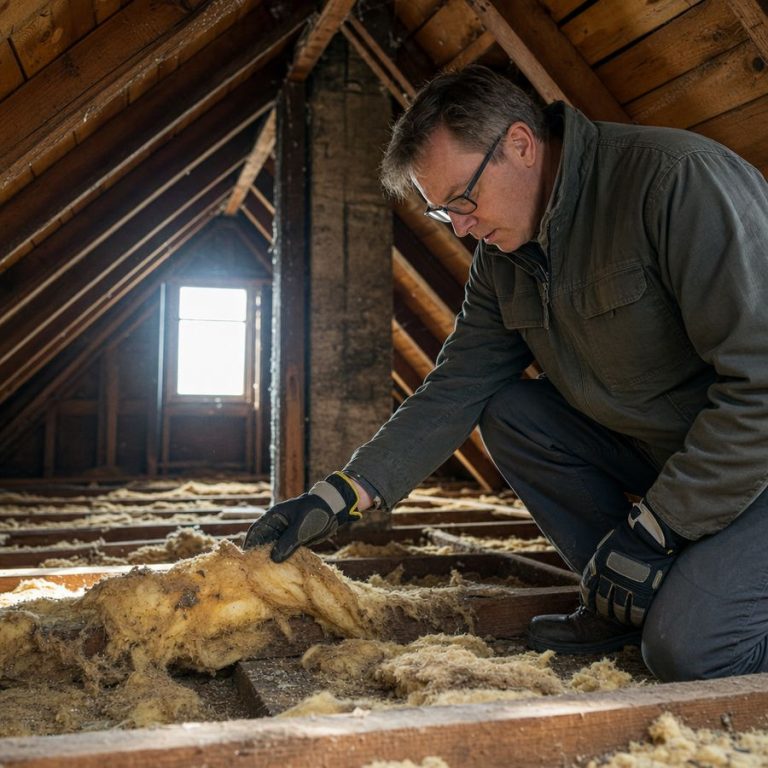
If you are comfortable doing an initial visual check through the attic hatch, look for the signs above using a bright flashlight — do not enter the attic space if you see droppings or evidence of active nesting without proper respiratory protection. Our step-by-step attic inspection guide walks you through what a safe initial inspection involves and when to stop and call a professional.
What Should You Do If You Find Pest-Damaged Attic Insulation in Calgary?
The steps below are organized in order. Do not skip the first one — it is the most important safety instruction in this article.
Step 1: Do not disturb contaminated material. This bears repeating because the instinct to clean up is strong — and it is the instinct that puts people at risk. Vacuuming, sweeping, or even stepping through contaminated insulation aerosolizes hantavirus particles. If you can see droppings or nesting material, treat the space as potentially contaminated and do not enter without an N95 respirator and rubber gloves at minimum. For significant infestations, call a professional immediately.
Step 2: Contact a pest control company first. Before insulation can be replaced, every animal must be removed and every entry point must be sealed — otherwise new insulation will be immediately recontaminated. Calgary pest control professionals use one-way exclusion doors (animals exit but cannot re-enter), steel mesh and metal flashing over gaps larger than 6 mm, and caulk or expanding foam for small cracks and utility penetrations. Overhanging tree branches that give roof access are typically recommended for trimming as a prevention measure.
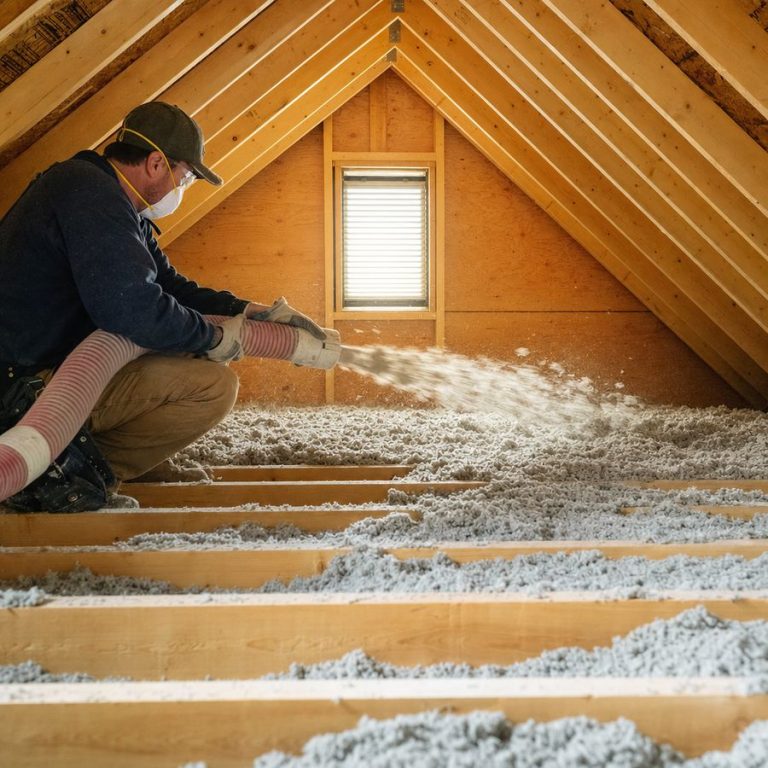
Step 3: Get a professional insulation removal and replacement assessment. Once the pest issue is resolved, the contaminated insulation needs to be removed by professionals with appropriate containment and HEPA-filtered vacuum equipment. This is not a DIY job for health reasons, not just skill reasons. Calgary restoration and insulation companies follow a documented process: containment of the attic space, full HEPA extraction of contaminated material, antimicrobial and antifungal treatment of all attic surfaces, double-bagging and disposal of waste according to Alberta environmental regulations, and reinstallation of new blown-in insulation to current R-60 code. Our dedicated attic insulation removal service is designed exactly for this scenario.
Step 4: Check your homeowner’s insurance. Insulation removal and replacement due to pest infestation may qualify for coverage under your homeowner’s policy, particularly if structural damage or electrical damage is involved. Always document the extent of the infestation with photographs before any work begins, and request detailed invoices from your pest control and insulation companies for your claim.
Step 5: Prevent recurrence. After reinstallation, the entry-point sealing done in Step 2 is your primary defence. Ask your insulation team about blown-in products that are less attractive to rodents than loose fiberglass. Maintain regular seasonal attic inspections — once per year is the minimum for Calgary homes, given how actively wildlife moves in during fall.
Frequently Asked Questions
How do I know if rodents have damaged my Calgary attic insulation?
The most reliable signs are sounds (scratching at night), smells (persistent ammonia from rodent urine), visible droppings near the attic hatch, and unexplained increases in your heating bill. If you see any of these, conduct a cautious visual check from the attic hatch opening only — do not enter without respiratory protection if droppings are visible.
Is pest-damaged attic insulation dangerous to my family in Calgary?
Yes, the risks are serious. Alberta has recorded 81 hantavirus cases and 15 deaths since 1989, and the disease is carried by deer mice common throughout Calgary. Infection occurs by inhaling disturbed particles from rodent droppings, urine, or nesting material — so disturbing contaminated insulation without protection can be life-threatening. Raccoon and bat droppings carry additional pathogens. Professional remediation is strongly recommended.
Can I replace pest-damaged attic insulation myself in Calgary?
For health and safety reasons, DIY removal of pest-contaminated insulation is strongly discouraged by Alberta Health Services and Health Canada. Disturbing rodent droppings without a P100 respirator, gloves, and proper containment creates real hantavirus exposure risk. Professional teams use HEPA-filtered vacuum systems, full containment, and antimicrobial treatment that cannot be replicated with consumer equipment. See our overview of DIY vs. professional attic insulation in Calgary.
How much does pest-damaged attic insulation replacement cost in Calgary?
Costs depend on the extent of the infestation and the size of the attic. Early intervention — infestation caught within one to two months — typically runs $800–$2,500 total for removal, sanitization, and reinstallation. Delayed response with six or more months of damage, including potential electrical and structural repairs, can reach $5,000–$12,000 or more. Acting quickly on warning signs is the single best way to control costs.
What insulation should go back in after pest removal in a Calgary attic?
After professional removal and sanitization, blown-in insulation (either cellulose or fiberglass) is typically recommended for Calgary attics. Both products can be installed to R-60 as required by the Alberta Building Code. Spray foam is used to seal entry points and penetrations, but is not the primary choice for full attic coverage due to cost. Your insulation contractor will recommend the right product for your attic configuration.
How Eco Attic Solutions Helps Calgary Homeowners After Pest Damage
Eco Attic Solutions has helped over 780 Calgary homeowners restore their attics to full thermal performance — including many whose insulation was compromised by rodents, squirrels, raccoons, and other pests. We handle the insulation side of the equation: professional removal of contaminated material, eco-friendly reinstallation to R-60 or better, and a 12-Month Workmanship Guarantee on every project. We work alongside pest control professionals to ensure the attic is clear and sealed before new insulation goes in.
Our attic insulation removal service is designed for exactly this kind of situation — thorough, safe, and tailored to Calgary’s building code requirements. We offer flexible financing with up to 6 months deferred payment to help Calgary homeowners manage the unexpected cost of insulation remediation, and our free, no-obligation quotes mean you know exactly what is involved before committing.
If you have heard something in the ceiling, noticed an unexplained rise in your heating bills, or spotted any of the warning signs described above, do not wait. The longer pest-damaged insulation remains in place, the more expensive the fix becomes — and the greater the health exposure for your family. Book a free attic assessment today or call us at (403) 990-9033. We serve Calgary and the surrounding area and are ready to help you protect both your home and your family.