Calgary homeowners are asking a new question alongside “will this insulation work?” — “is it good for the planet?” With energy costs climbing and sustainability at the top of mind, eco-friendly attic insulation is no longer a fringe choice. It is a smart, practical upgrade for any homeowner who wants to stay warm through -30°C winters, hit the National Building Code’s R-60 attic requirement, and reduce their carbon footprint at the same time. The good news: green insulation options perform just as well as conventional alternatives — and in many cases, better.
Quick Answer
The best eco-friendly attic insulation options for Calgary homes are cellulose (80–85% recycled newspaper, R-3.6/inch average) and mineral wool (made from volcanic rock or recycled slag, R-3.7–4.2/inch). Both achieve Calgary’s mandatory R-60 attic rating in Climate Zone 7A while significantly lowering embodied carbon versus conventional fiberglass.
What Does “Eco-Friendly” Attic Insulation Actually Mean?
When insulation is marketed as “eco-friendly,” it generally means one or more of the following: a high proportion of recycled or reclaimed content, lower embodied carbon during manufacturing, the absence of harmful chemical binders or blowing agents, and long service life that reduces the frequency of replacement. Not every product ticks all these boxes equally — so understanding what each label actually means helps you choose the right material for your home and your values.
Embodied carbon is a term that describes the greenhouse gases released during the extraction, manufacture, and transport of a building material — before it ever reaches your attic. Natural Resources Canada’s “Keeping the Heat In” guide confirms that plant-based and recycled-content materials like cellulose typically carry lower embodied carbon factors than synthetic or virgin-mineral products. This matters because insulation that saves energy for 30 years while emitting very little during production offers a genuine double benefit for Calgary homeowners trying to shrink their overall climate impact.
Durability is another dimension of eco-friendliness that often goes unmentioned. An insulation material that lasts 50 years without needing replacement is far greener than a cheaper option that degrades in 15 years and ends up in a landfill. When evaluating your options, factor in not just upfront material credentials but also how the product performs over the long haul in Calgary’s climate — one that swings from -35°C Arctic outflows to Chinook-driven thaws in the same week. You can learn more about how insulation ages in our guide to how often you should replace attic insulation in Calgary homes.
Cellulose Insulation: Calgary’s Most Popular Green Choice
Cellulose is the flagship eco-friendly insulation product for good reason: it is made from 80–85% post-consumer recycled newspaper, making it one of the highest recycled-content building materials available. That newspaper is shredded, processed, and treated with borate compounds — a naturally occurring mineral salt that provides fire resistance, pest deterrence, and protection against fungal growth. The result is an insulation product whose environmental story begins before it even reaches your attic, diverting waste paper from landfills and requiring far less energy to manufacture than fiberglass or foam alternatives.
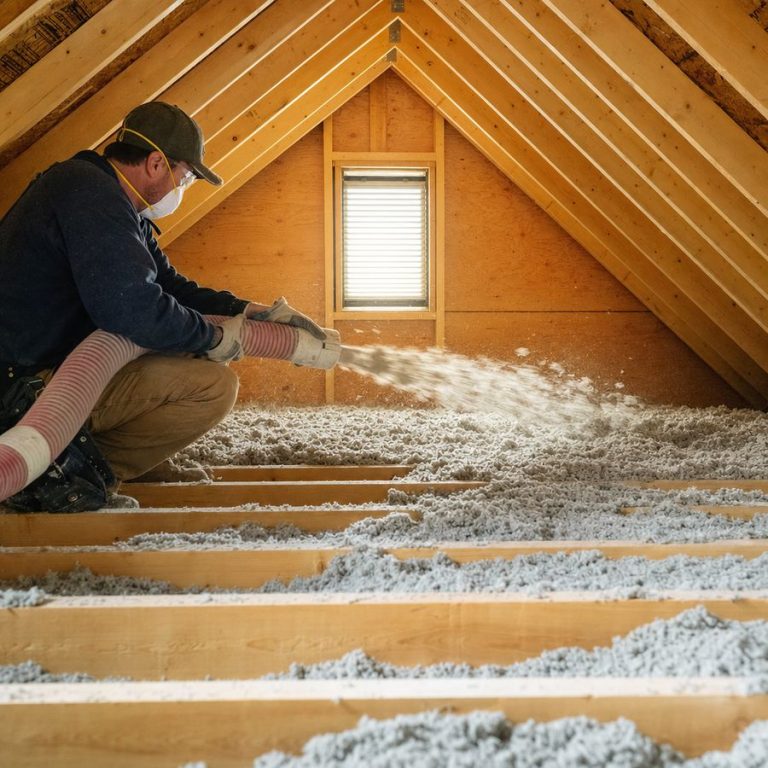
For Calgary attics in Climate Zone 7A, achieving the code-minimum R-60 requires approximately 16–17 inches of blown-in cellulose (using the NRCan design average of R-3.6 per inch). This makes it an ideal choice for residential attic insulation upgrades because the loose-fill blown-in method fills every gap, joist bay, and irregular corner in a way that batt insulation simply cannot. Air sealing happens simultaneously as the dense pack settles into place, further boosting your home’s overall thermal efficiency.
One performance characteristic that stands out in Calgary’s climate is cellulose’s behaviour during Chinook cycles. When temperatures swing from -25°C to +12°C within 24 hours, insulation materials are tested. Cellulose’s fibrous matrix is stable across that temperature range and resists settling after thermal cycling. The borate treatment also means it holds up well against the occasional moisture intrusion that can occur when warm indoor air meets a cold attic deck — though proper vapour barriers and ventilation remain essential companions to any insulation. Learn more about how air sealing works alongside insulation in our article on why professional attic insulation installation beats DIY.
Mineral Wool (Rockwool): The Fire-Safe, Durable Eco Option
Mineral wool insulation — sold under brand names such as Rockwool and Roxul — is manufactured from either volcanic basalt rock or blast furnace slag, a byproduct of steel production. Both raw materials are either naturally abundant or are industrial byproducts being diverted from waste streams, giving mineral wool strong eco credentials from a resource-use perspective. The manufacturing process does consume energy, but the material’s exceptional durability — it does not degrade, compress, or lose R-value over decades — means the lifecycle environmental calculation is favourable compared to products that need periodic replacement.
The R-value range for mineral wool runs from R-3.7 to R-4.2 per inch depending on density and product format. At the high end, that means you can reach R-60 with about 14–15 inches of product — slightly less depth than cellulose for the same thermal performance. Mineral wool also holds a significant advantage when it comes to fire resistance: it does not melt or contribute fuel to a fire until temperatures exceed 1,000°C, well above any residential fire scenario. This makes it an appealing choice in attics where fire-stopping is a concern, including homes with open-plan top floors or attic hatches that connect directly to living areas.
Sound attenuation is another strong selling point. Mineral wool’s dense fibrous structure absorbs sound waves effectively — a practical benefit in Calgary neighbourhoods with air traffic or busy roads nearby, and for homeowners who have a noisy mechanical room or master bedroom directly below the attic. For commercial attic insulation projects in mixed-use buildings, mineral wool’s fire and acoustic performance often makes it the specification of choice for architects and engineers.
How Do Eco-Friendly Insulation Options Compare in Calgary’s Zone 7A Climate?
Choosing between cellulose and mineral wool ultimately comes down to your budget, your attic’s existing conditions, and your priorities. The table below compares the two leading eco-friendly options alongside conventional fiberglass for reference:
| Feature | Cellulose | Mineral Wool | Fiberglass (Blown-in) |
|---|---|---|---|
| Recycled Content | 80–85% | 40–75% (slag type) | 30–60% (varies) |
| R-Value / Inch | R-3.6 (avg) | R-3.7–4.2 | R-2.2–3.0 |
| Fire Resistance | Good (borate-treated) | Excellent (melts at 1,000°C+) | Moderate |
| Moisture Handling | Good (dries without damage) | Excellent (hydrophobic) | Poor (absorbs, loses R-value) |
| Sound Dampening | Good | Excellent | Moderate |
| Approximate Cost/sq ft (installed) | $1.50–$2.50 | $2.00–$3.50 | $1.00–$2.00 |
| Eco Score | ★★★★★ | ★★★★☆ | ★★★☆☆ |
Both cellulose and mineral wool comfortably meet the National Building Code – Alberta Edition’s RSI 10.43 (R-60) requirement for attic ceilings in Calgary. Fiberglass blown-in, while cheaper upfront, requires more depth to hit R-60 and delivers lower eco credentials — a trade-off worth thinking carefully about if environmental performance is a priority for you. For a deeper comparison of insulation formats, see our breakdown of blown-in insulation vs. batts for Calgary homes.
Can You Get Financial Help for Eco-Friendly Attic Insulation in Calgary?
The federal Canada Greener Homes Grant closed to new applicants in 2024, but Calgary homeowners still have meaningful financial tools available in 2026. The primary pathway is the Clean Energy Improvement Program (CEIP), a City of Calgary initiative that provides low-interest financing attached to your property rather than your personal credit — meaning no large upfront payment is required, and the loan transfers to the new owner if you sell. Eco-friendly insulation upgrades including cellulose and mineral wool installations qualify under this program.
Income-qualifying homeowners may also be eligible for the City of Calgary Home Upgrades Program, which provides direct funding — not loans — for energy efficiency improvements including attic insulation. Utility rebates from ENMAX and ATCO Gas can often be stacked on top of CEIP financing, further reducing your net out-of-pocket cost. Eco Attic Solutions offers flexible financing up to 6 months deferred to bridge any remaining gap while you navigate program approvals. Visit our page on residential attic insulation for more detail on what an upgrade project typically involves, or check our insulation FAQ for answers to common financing questions. You can also read our detailed breakdown of the cost of blown-in attic insulation in Calgary.
Is Eco-Friendly Insulation Worth It for Your Calgary Home?
The short answer is yes — and the math backs it up. A properly insulated attic at R-60 can reduce heating and cooling losses by 25–40% compared to an under-insulated home, translating to hundreds of dollars in annual savings on natural gas and electricity bills. When you choose a high-recycled-content product like cellulose, those energy savings compound with lower manufacturing emissions, creating a double environmental dividend that aligns with the values of an increasing number of Calgary homeowners.
There is also a practical consideration specific to Calgary: the city’s Chinook cycles put unusual mechanical stress on building materials through repeated freeze-thaw. Both cellulose and mineral wool handle these cycles better than lower-density fiberglass batts, which can gap and settle over time. An eco-friendly upgrade is therefore not just a values statement — it is often the more durable, longer-lasting choice for a house that has to survive a genuinely extreme climate. Curious how much you could save? Read more about how attic insulation upgrades lower Calgary energy bills.
Frequently Asked Questions
What is the most eco-friendly attic insulation for a Calgary home?
Cellulose insulation is generally considered the most eco-friendly choice for Calgary attics because it contains 80–85% recycled post-consumer newspaper, has a low embodied carbon footprint, and is treated with borate — a naturally occurring mineral — rather than synthetic chemicals. It achieves the required R-60 attic rating in about 16–17 inches and performs well through Calgary’s freeze-thaw cycles.
How much does eco-friendly attic insulation cost in Calgary?
Blown-in cellulose typically runs $1.50–$2.50 per square foot installed in Calgary, while mineral wool insulation costs $2.00–$3.50 per square foot. For an average 1,200 sq ft attic, expect $1,800–$4,200 before rebates or financing. The Clean Energy Improvement Program (CEIP) offers low-interest financing with no upfront payment required for qualifying Calgary homeowners.
Is cellulose insulation safe for Calgary homes?
Yes. Cellulose insulation used in Canada must meet Canadian consumer product safety standards and is treated with borate compounds that are fire-retardant and non-toxic to humans and pets. It does not off-gas VOCs, does not contain formaldehyde, and is safe for enclosed attic spaces. Natural Resources Canada lists it as a compliant and widely used insulation material in the Keeping the Heat In guide.
Does eco-friendly insulation meet Calgary’s R-60 building code requirement?
Yes. Both cellulose (R-3.6/inch) and mineral wool (R-3.7–4.2/inch) easily achieve Calgary’s mandatory R-60 attic requirement — the standard set by the National Building Code – Alberta Edition for homes in Climate Zone 7A. Approximately 16–17 inches of blown-in cellulose, or 14–15 inches of mineral wool, will meet or exceed the code minimum.
How long does eco-friendly attic insulation last in Calgary?
Properly installed cellulose and mineral wool insulation can last 30–50 years or more in a Calgary attic. Neither material degrades significantly with age when protected from prolonged moisture exposure. Eco-friendly options often outlast conventional fiberglass, which can settle and lose R-value over time — making the greener choice also the longer-lasting investment.
How Eco Attic Solutions Helps Calgary Homeowners Go Green
At Eco Attic Solutions, eco-friendly insulation is not a marketing add-on — it is core to who we are. Our team specializes in cellulose and other low-impact insulation materials, installed by trained professionals who understand Calgary’s unique climate demands. Every project comes backed by our 12-Month Workmanship Guarantee, so you can invest in a greener home with complete confidence in the quality of the work.
We have helped over 780 Calgary homeowners upgrade their attics with materials that are better for the planet and better for their energy bills. Whether you are starting fresh with a full attic insulation removal and replacement or topping up an existing installation to reach R-60, our team will assess your attic, recommend the right eco-friendly product for your situation, and handle everything from start to finish.
Ready to make your Calgary home greener and more comfortable? Book a free, no-obligation quote today. Call us at (403) 990-9033 or visit our contact page to get started. Flexible financing options — including up to 6 months deferred — are available to help make your eco-friendly upgrade as affordable as possible.