Every Calgary homeowner who decides it’s time to upgrade their attic insulation faces the same crossroads: spray foam or blown-in? Both materials can help you reach Alberta’s required R-60, both are installed by professionals, and both will meaningfully reduce your energy bills. But they work in completely different ways, cost very different amounts, and perform differently in Calgary’s punishing Climate Zone 7A conditions — where Chinook winds can swing temperatures 25°C in a single afternoon and January cold snaps routinely hit -30°C. Choosing the wrong product for your attic’s specific situation can cost you thousands extra upfront, or leave you short on performance when it matters most.
Quick Answer
For most Calgary homes, blown-in cellulose or fiberglass over a professionally air-sealed ceiling is the most cost-effective path to R-60, at $1.50–$2.50/sq ft versus $3.50–$7.00/sq ft for closed-cell spray foam. Spray foam excels in unvented attics, cathedral ceilings, or when extreme air sealing is required. A professional assessment determines which best suits your home.
What Is Blown-In Attic Insulation — and How Does It Work in Calgary’s Climate?
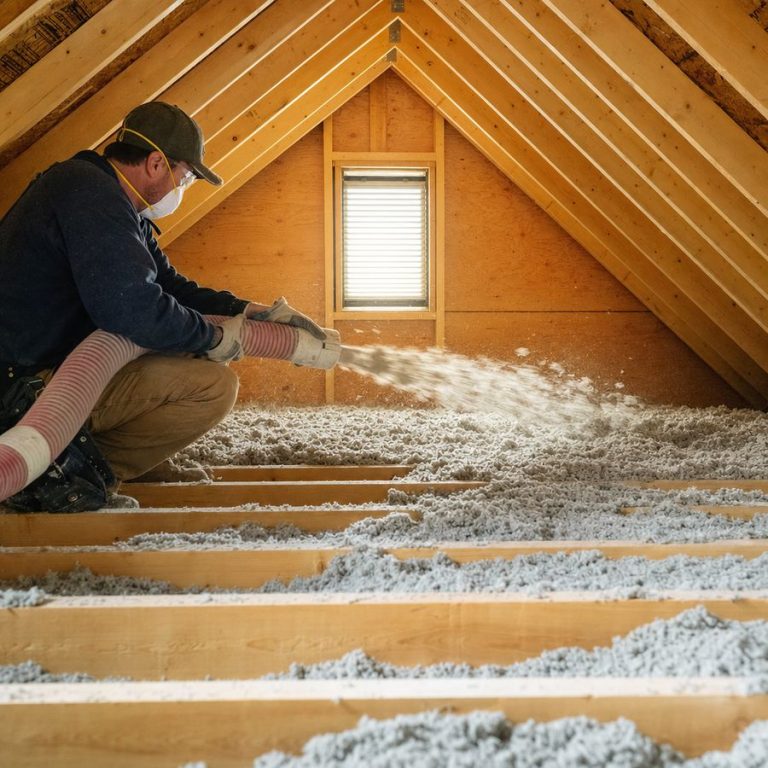
Blown-in insulation — also called loose-fill insulation — consists of small fibres or particles of either cellulose (recycled paper) or fiberglass that are machine-blown into your attic space through a large hose. The material fills every contour of the attic floor, conforming around joists, blocking, electrical boxes, and other obstructions to create a continuous blanket of thermal resistance. To reach R-60 in a Calgary attic, you’ll need approximately 17–18 inches of blown cellulose or 22–24 inches of blown fiberglass, installed on top of a properly air-sealed attic floor.
The key word in that last sentence is on top of a properly air-sealed attic floor. Blown-in insulation is an excellent thermal barrier, but it doesn’t air-seal on its own. Air leaks through electrical boxes, plumbing penetrations, and gaps around chimneys must be sealed with spray foam, caulk, or rigid foam board before the blown-in material is added. When air sealing is done first, blown-in insulation performs beautifully in Calgary’s climate — the combination stops both conductive heat loss (the slow, steady bleed through insulation) and convective heat loss (the rapid, costly bleed through gaps and cracks). Natural Resources Canada’s Keeping the Heat In guide states unambiguously that “the importance of air sealing cannot be overstated” — and blown-in insulation works best when this step is not skipped.
One important performance note: blown-in insulation settles slightly over time. Research from Canadian insulation contractors shows that blown cellulose and fiberglass can lose 10–20% of their initial R-value within a decade through settling and compression. This is why professional installers target slightly above R-60 at installation — to ensure you still meet code requirements years down the road. Our article on how often to replace attic insulation in Calgary covers the full lifespan picture.
What Is Spray Foam Attic Insulation — and When Does It Make Sense?
Spray foam insulation is a two-component liquid system that expands and hardens when applied, simultaneously insulating and air-sealing whatever surface it contacts. There are two main types: open-cell spray foam and closed-cell spray foam, and they behave quite differently. Open-cell spray foam is soft and spongy, delivers approximately R-3.7 per inch, and is vapour-permeable — meaning moisture can pass through it over time. Closed-cell spray foam is rigid and dense, delivers R-6 to R-7 per inch, and acts as both an air barrier and a vapour barrier. To reach R-60 with open-cell foam, you’d need approximately 16 inches; with closed-cell, about 9–10 inches.
The defining advantage of spray foam is that it does two jobs at once: insulate and air-seal. In standard vented attic applications, this dual function is somewhat redundant if your attic floor is properly air-sealed before blown-in is added. But in unvented attic systems — where the insulation is applied directly to the underside of the roof deck rather than the attic floor — spray foam is often the only practical choice. Unvented attics are increasingly common in new Calgary construction and in homes with cathedral ceilings, where traditional ventilation would be difficult to achieve. Spray foam on the roof deck brings the attic space inside the thermal envelope of the home, eliminating the attic as a separate cold zone entirely.
Spray foam is also valuable as a targeted air-sealing tool, even in attics that will be primarily insulated with blown-in material. A professional insulation contractor will often use a small amount of spray foam to seal the most problematic penetrations — top plates, plumbing stacks, electrical can lights — before filling the rest of the space with blown-in cellulose. This hybrid approach captures spray foam’s air-sealing precision without applying it everywhere at its full per-square-foot cost.
How Do the R-Values Compare for Calgary’s R-60 Requirement?
| Insulation Type | R-Value per Inch | Depth Needed for R-60 | Cost per Sq Ft (Installed) |
|---|---|---|---|
| Blown-In Cellulose | ~R-3.2 to R-3.8 | ~17–19 inches | $1.50–$2.50 CAD |
| Blown-In Fiberglass | ~R-2.2 to R-2.7 | ~22–27 inches | $1.50–$2.25 CAD |
| Open-Cell Spray Foam | ~R-3.5 to R-3.7 | ~16–17 inches | $1.50–$3.00 CAD |
| Closed-Cell Spray Foam | ~R-6 to R-7 | ~9–10 inches | $3.50–$7.00 CAD |
The table above makes the cost difference stark. A 1,500-square-foot Calgary attic insulated with blown-in cellulose to R-60 might cost $2,250 to $3,750 installed. The same attic done entirely in closed-cell spray foam could cost $5,250 to $10,500 — two to four times as much. For most standard vented attics in Calgary bungalows and two-storey homes, that price difference is very difficult to justify when blown-in over air-sealed penetrations achieves the same code-required R-value.
However, the R-value per inch advantage of closed-cell foam becomes genuinely important in space-constrained applications. If you have a low-slope roof section, a knee wall, or a cathedral ceiling where physical depth is limited, closed-cell foam’s ability to deliver R-60 in about 10 inches — compared to 22+ inches for fiberglass — can be the deciding factor. In these situations, there may be no practical alternative. If you’re comparing options for a standard attic with ample headroom, the depth advantage is moot. See our detailed comparison of blown-in insulation versus batts for another angle on this decision.
Which Insulation Type Handles Calgary’s Extreme Cold and Chinook Swings Better?
Calgary’s climate creates two specific challenges that matter to this comparison. The first is sustained extreme cold: temperatures below -25°C for days or weeks at a time, during which your insulation’s thermal resistance is under continuous maximum stress. Both blown-in and spray foam perform well under sustained cold — the R-value per inch specifications are measured at standard conditions and hold up through cold snaps. Closed-cell spray foam has a slight edge in very cold conditions because its rigid structure doesn’t compress or shift, maintaining its stated R-value indefinitely. Blown-in insulation is affected by gravity and moisture over time, as noted above.
The second challenge is Chinook-driven pressure and temperature cycling. When a Chinook arrives and outdoor temperatures jump 20–25°C within hours, pressure differences across your home’s envelope shift dramatically. Any gaps or cracks in the building envelope allow air to move through at an accelerated rate. This is where spray foam’s built-in air sealing becomes genuinely valuable in Calgary specifically — it creates a seamless, gap-free barrier that doesn’t flex or crack under thermal cycling the way caulk and gaskets can over time. If your attic floor has a high density of penetrations — recessed lighting, multiple HVAC chases, complex framing — the air sealing advantage of spray foam is more meaningful in a Calgary home than it would be in a milder climate.
That said, Natural Resources Canada’s insulation materials guide confirms that cellulose blown-in insulation performs very well in cold Canadian climates — it was specifically developed for this use case. Dense-pack cellulose in particular resists settling and air infiltration better than standard loose-fill fiberglass, making it a strong performer in Calgary’s Zone 7A conditions when properly installed.
Which Option Is More Eco-Friendly for Calgary Homeowners?
Environmental impact is an increasingly important factor for Calgary homeowners, and the two material types differ meaningfully on this dimension. Blown-in cellulose is made from approximately 80% post-consumer recycled paper content — primarily old newspapers and cardboard — treated with non-toxic borate compounds for fire and pest resistance. It has a very low embodied carbon footprint, and because it’s a recycled product, choosing cellulose actively supports the circular economy. For homeowners prioritizing sustainability, blown-in cellulose is the clear winner.
Blown-in fiberglass has a higher embodied energy than cellulose but is still significantly more eco-friendly than spray foam. Open-cell spray foam uses water as its blowing agent, which reduces its climate impact compared to older formulations, and it doesn’t off-gas once cured. Closed-cell spray foam historically used hydrofluorocarbon (HFC) blowing agents with high global warming potential; newer formulations use lower-GWP alternatives, but the product still carries a substantially higher embodied carbon footprint than either blown-in option.
This doesn’t mean spray foam is the wrong choice — when its air sealing performance prevents years of moisture infiltration and structural damage, the lifetime energy savings can offset its embodied carbon. But for a standard vented attic where blown-in over air-sealed penetrations achieves the same performance outcome, cellulose is both the more eco-friendly and the more economical choice. Our residential insulation services include eco-friendly blown-in cellulose options for homeowners who want strong performance and a lighter environmental footprint.
When Should Calgary Homeowners Choose Spray Foam vs. Blown-In?
The decision comes down to your attic’s geometry, the density of penetrations in the attic floor, your budget, and whether your attic is vented or unvented. Use this practical guide:
- Choose blown-in (over air-sealed attic floor) when: your attic is a standard vented design with adequate headroom; you’re working with a clear budget; environmental impact matters to you; or you’re upgrading an existing home with a straightforward attic layout. This is the right choice for the vast majority of Calgary bungalows, bi-levels, and two-storey homes.
- Choose spray foam on the roof deck when: your attic is unvented (spray foam on the roof deck is then applied to bring the rafter cavity inside the thermal envelope); you have a cathedral ceiling or flat roof section; or physical depth is severely constrained and you need high R-value per inch.
- Choose a hybrid approach when: your attic floor has a high density of penetrations, older can lights, or complex framing that makes perfect air sealing with caulk and foam board difficult — use spray foam on those specific penetrations, then blown-in over everything else. This captures spray foam’s precision air sealing at a fraction of the cost of spray foaming the entire space.
Whatever option you’re considering, a professional site assessment is essential before committing to a product. An experienced Calgary insulation contractor will evaluate your attic’s ventilation, existing insulation condition, penetration density, and structural situation before recommending an approach. The difference between a properly matched insulation strategy and a mismatched one can be thousands of dollars and years of performance. Our article on the cost of blown-in attic insulation in Calgary provides a detailed breakdown of what to budget for the most common upgrade scenario, while our DIY vs. professional insulation comparison explains why professional installation consistently delivers better results in Calgary’s demanding climate.
Frequently Asked Questions
Is spray foam or blown-in insulation better for Calgary attics?
For most Calgary homes with standard vented attics, blown-in cellulose or fiberglass over a professionally air-sealed attic floor delivers equivalent performance to spray foam at roughly half the cost. Spray foam is the better choice for unvented attics, cathedral ceilings, or depth-constrained spaces. A professional assessment will identify the right fit for your specific home.
How much does spray foam attic insulation cost in Calgary compared to blown-in?
In Calgary, blown-in insulation runs approximately $1.50 to $2.50 per square foot installed. Closed-cell spray foam costs $3.50 to $7.00 per square foot — two to four times more. For a 1,500 sq ft attic, the difference can be $3,000 to $8,000. The higher cost of spray foam is only justified in specific applications where it outperforms blown-in.
Does spray foam insulation work better in Calgary winters?
Closed-cell spray foam maintains its R-value without settling, which is a minor advantage in Calgary’s extreme cold. However, blown-in cellulose installed to the correct depth performs very well in Climate Zone 7A. The more important variable is air sealing — both product types work well when the attic floor is properly sealed before or during installation.
What R-value do I need for my Calgary attic, and which insulation reaches it most affordably?
Alberta’s Building Code requires R-60 (RSI 10.43) for attic ceilings in Calgary’s Climate Zone 7A. Blown-in cellulose reaches R-60 at approximately 17–19 inches depth and is typically the most affordable route, at $1.50–$2.50/sq ft installed. Closed-cell spray foam reaches R-60 in about 10 inches but costs significantly more per square foot.
Can I mix spray foam and blown-in insulation in my Calgary attic?
Yes — and for many Calgary homes, a hybrid approach is the smartest choice. Spray foam is applied to seal specific penetrations (electrical boxes, plumbing stacks, recessed lights, top plates), then blown-in insulation fills the rest of the attic floor to achieve R-60. This captures spray foam’s precision air-sealing at a fraction of the cost of foaming the entire attic.
How Eco Attic Solutions Helps You Choose the Right Insulation for Your Calgary Home
At Eco Attic Solutions, we don’t sell you a product — we solve your attic’s specific problem. With more than 780 Calgary homeowners served and deep expertise in Climate Zone 7A conditions, our team assesses each attic individually before recommending blown-in, spray foam, or a hybrid approach. We’ll tell you exactly what R-value you currently have, what it needs to reach R-60, and the most cost-effective path to get there — including available rebates and financing.
Our residential attic insulation upgrades use eco-friendly materials and professional installation techniques to reach R-60 consistently across the entire attic floor — including around penetrations and at the critical eaves where blown-in depth is hardest to achieve. Every project includes a 12-Month Workmanship Guarantee, and flexible financing with up to 6 months deferred means you can start saving on energy bills immediately while spreading out the project cost. Have questions before booking? Visit our attic insulation FAQ for quick answers, or call us directly.
Ready to find out which insulation is right for your Calgary attic? Book your free, no-obligation assessment today. Call (403) 990-9033 or visit our contact page to schedule at a time that works for you. Calgary’s insulation season is year-round — and the sooner you upgrade, the sooner your energy bills reflect it.